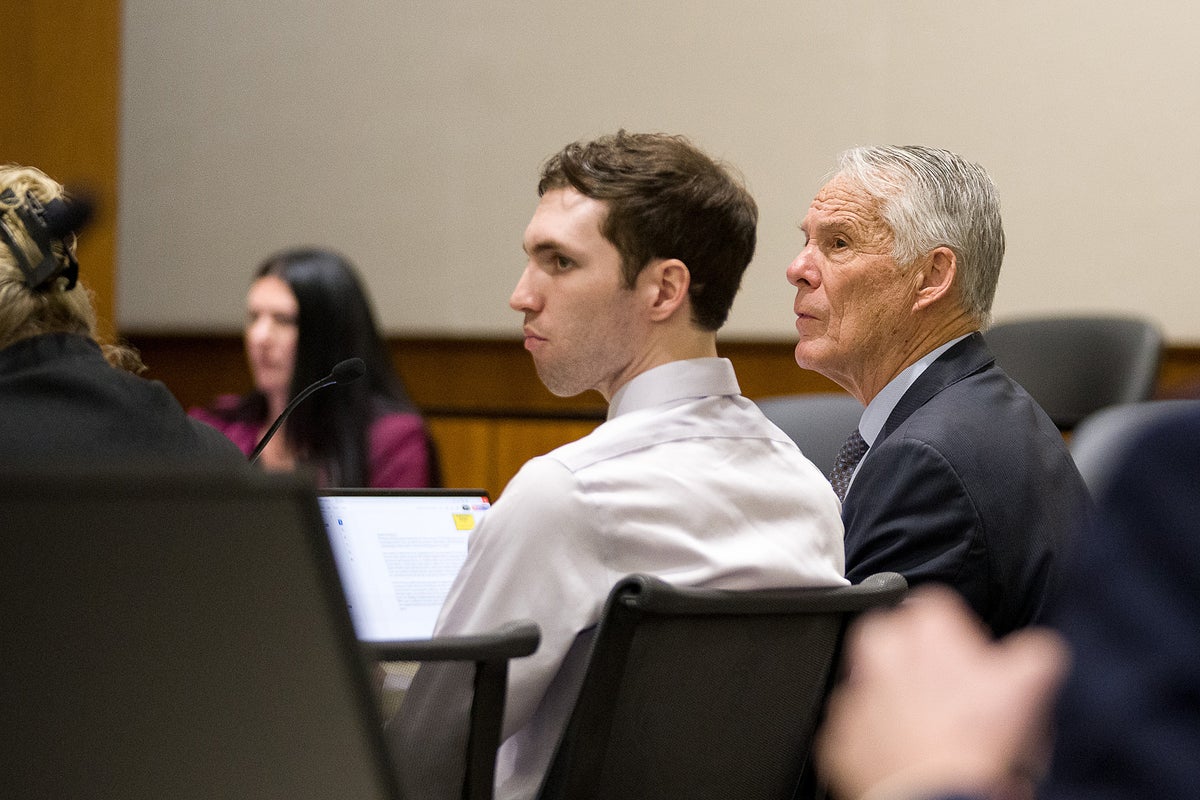
The high-stakes legal battle surrounding the assassination of conservative activist Charlie Kirk just hit a critical junction in a Utah courtroom. On Monday morning, 4th District Judge Tony Graf handed prosecutors a significant procedural victory by deciding that a key witness will not be forced to take the stand yet. Specifically, the judge ruled that the Charlie Kirk shooting suspect’s roommate will not have to testify in person during the upcoming preliminary hearing.
This decision changes the immediate dynamics of one of the most closely watched capital murder cases in recent American history. Tyler Robinson, the 23-year-old accused of firing the fatal shot, wanted his former roommate and romantic partner, known in court documents as Twiggs, on the witness stand right away. His defense team argued that facing this witness under cross-examination was crucial for his constitutional rights. Judge Graf disagreed. He made it clear that a preliminary hearing has a narrow, specific function under Utah law. It is not a full-scale trial to determine guilt or innocence. It is a gateway to see if there is enough basic evidence to move forward.
By denying the defense request, the court has allowed prosecutors to rely on a video-recorded interview with the roommate instead of putting them through a live interrogation. For anyone tracking this case, this ruling offers a massive window into how high-profile criminal procedures actually work when politics, media frenzies, and complex forensics collide.
The Massive Difference Between a Preliminary Hearing and a Trial
A lot of people confuse a preliminary hearing with an actual trial. They assume that every constitutional safeguard, like the immediate right to confront your accusers face-to-face, applies equally at every step. That is simply not how the American legal system operates.
In Utah, a preliminary hearing serves as a screening mechanism. The prosecution faces a remarkably low burden of proof compared to the "beyond a reasonable doubt" standard required for a conviction. They only need to establish probable cause. They have to show that a crime was committed and that there is a reasonable probability the defendant did it.
Because the stakes at this stage are about proceeding to trial rather than sending someone to prison, the rules of evidence are relaxed. The Utah Supreme Court has consistently held that hearsay evidence is perfectly acceptable during these initial screenings. Hearsay means a statement made outside the courtroom, like a police report or a recorded interview, introduced to prove the truth of the matter asserted.
The defense argued heavily that using a recorded video interview instead of a live witness violated Robinson's right to confront those speaking against him. They wanted to test the roommate's credibility immediately. Judge Graf shut that argument down directly. He noted that evaluating whether a witness is telling the truth is a job reserved for a jury during a full trial. At the preliminary stage, the state just needs to show its cards to prove the case is not frivolous.
The Text Messages That Anchor the Prosecution Case
To understand why the defense fought so hard to get the roommate on the stand, you have to look at what that roommate allegedly told investigators. The state's case does not just rely on forensic science. It relies heavily on a digital paper trail that points directly to a motive.
According to prosecutors, Robinson sent deeply incriminating text messages to his roommate shortly around the time of the shooting. In those messages, Robinson allegedly confessed to targeting Kirk. The text reportedly stated that he did it because he "had enough of his hatred."
If a jury hears that text message alongside a video of the roommate confirming Robinson sent it, the defensive wall becomes incredibly hard to build. The defense team wanted the opportunity to grill the roommate in public, looking for inconsistencies, signs of coercion, or alternative explanations for those messages before the case ever gets formally greenlit for a capital trial. By keeping the roommate off the stand for now, the judge has protected the prosecution's narrative from being chipped away early. The state can simply play the recorded interview, call the investigating officers to the stand, and clear the low hurdle of probable cause with relative ease.
The Gathering Storm Over DNA and Ballistics Evidence
While the text messages provide a clear narrative line for the state, the physical evidence is becoming a fierce battleground. This case has already ignited a firestorm of online speculation, and the technical details explain why.
Kirk was shot in the neck on September 10, 2025, while addressing a massive crowd at Utah Valley University. It was a chaotic scene. When the police recovered the suspected murder weapon, a rifle, they ran standard forensic panels. Prosecutors state that DNA consistent with Robinson's profile was found on three critical spots:
- The trigger of the rifle
- The fired cartridge casing
- Two unfired cartridges found at the scene
On paper, that looks like a slam dunk. But criminal defense work lives in the nuances. Robinson's attorneys have publicly noted that the forensic reports are far more complicated than a simple match. They point out that multiple people's DNA profiles were found on some of these recovered items. They argue that the presence of secondary and tertiary DNA requires a much more sophisticated analysis than what the state is presenting.
Then there is the ballistics issue. Court documents revealed that initial laboratory tests were inconclusive regarding whether the recovered bullet was actually fired from that specific rifle.
In the modern media environment, that word "inconclusive" acted like lighter fluid. It triggered a wave of unverified online conspiracy theories suggesting everything from a second hidden shooter to a completely staged event. Legal experts know that inconclusive ballistics tests are common, especially when a bullet suffers severe impact distortion. However, in a case with immense political polarization, physical ambiguity creates massive leverage for the defense.
The Contempt Dispute and Media Battles
The tension in the courtroom is not just between the defendant and the state. It is also an intense fight between the opposing lawyers. Alongside the witness dispute, Judge Graf has been forced to deal with accusations of prosecutorial misconduct.
Robinson's defense attorneys accused Deputy Utah County Attorney Christopher Ballard of orchestrating a calculated "media tour." They claimed prosecutors intentionally discussed ballistics testing publicly to influence the local jury pool and salvage a weak physical case. The defense went so far as to ask the judge to hold the prosecution office in contempt of court and block them from pursuing the death penalty entirely.
During a heated hearing on June 12, Ballard defended his actions. He argued that he never leaked specific, non-public details about the Robinson investigation. He maintained that his media comments were purely educational, explaining to reporters how ballistics testing works generally and why inconclusive results happen in normal criminal investigations.
Judge Graf chose to split his decisions. While he ruled decisively on the roommate's testimony on Monday, he delayed his ruling on the contempt charges. That decision is expected to come down this Friday. It keeps both legal teams on edge as they prepare for the formal preliminary hearing, which is scheduled to run from July 6 to July 10.
What Happens Next in the Legal Process
The ruling on the roommate's testimony sets a clear trajectory for the next month. The legal maneuvering we are seeing now is all about positioning before the real fight begins. If you are watching this case develop, here are the concrete steps and strategies that will unfold next.
First, expect the defense to continue its aggressive push to limit public exposure. Robinson's legal team is currently renewing efforts to ban all cameras and microphones from the courtroom during the July preliminary hearing. They know the political nature of the victim makes an unbiased jury in Utah incredibly difficult to find. Every broadcasted hour of evidence makes their job harder.
Second, the defense will use the July 6 hearing to map out the state's exact forensic timeline. Even though they cannot cross-examine the roommate yet, they will heavily cross-examine the police officers who took the roommate's statement. They will look for gaps in how the rifle was recovered, how the DNA samples were preserved, and the exact timing of the text messages.
Third, look out for the Friday ruling on the contempt motion. If Judge Graf issues a reprimand or sanctions against the prosecutors, it will give the defense an immediate rhetorical weapon to argue that the state is acting out of political bias rather than a dedication to justice.
This case is moving forward rapidly, and the relaxed evidentiary rules of the upcoming preliminary hearing mean Robinson will almost certainly be ordered to stand trial. The real test of the state's evidence, the text messages, and the true identity of the DNA profiles will be saved for that destination.