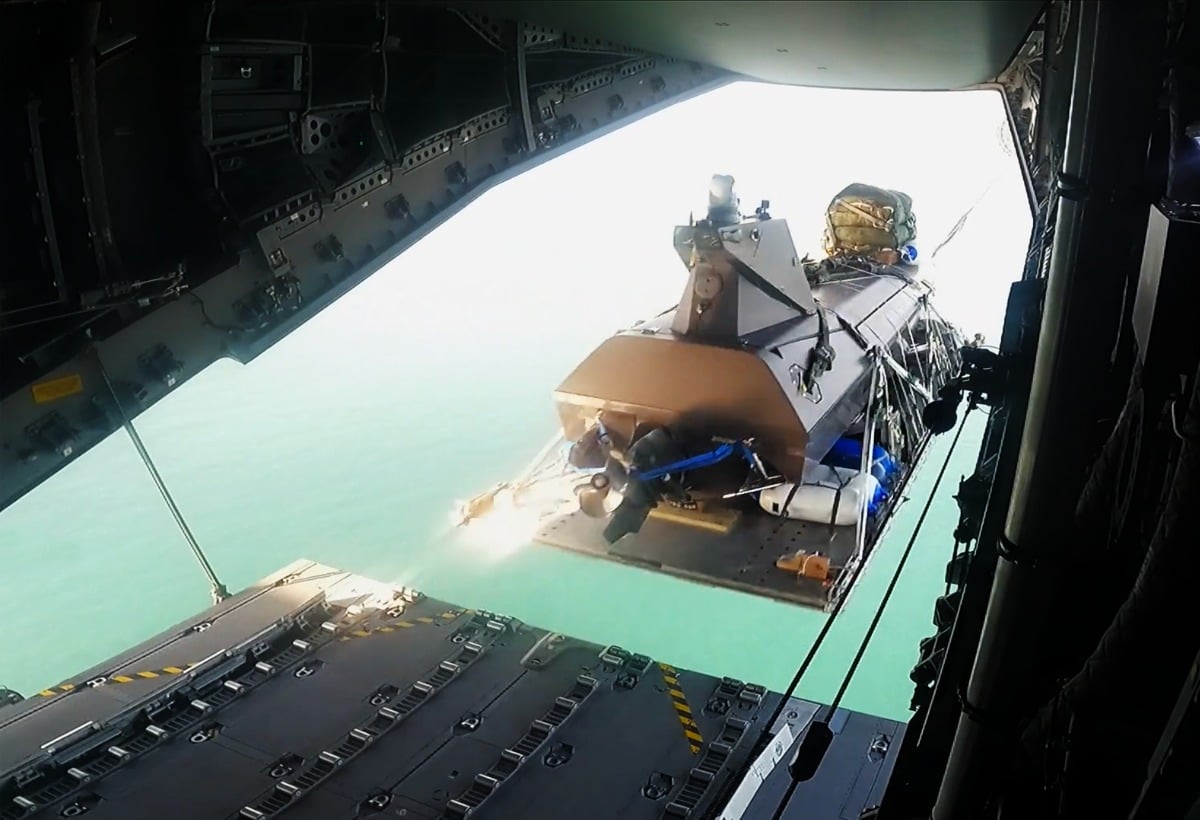
Dropping a boat out of the back of a moving military transport plane is usually an effective way to break it. Doing it four times in less than a week without a single human crew member on board to fix things if they go wrong sounds like a recipe for a very expensive salvage operation.
Yet the UK Royal Navy just pulled it off. In a series of trials over the North Sea, a military transport aircraft pushed an uncrewed surface vessel from its cargo ramp at 1,300 feet. The boat hit the water, cleared its parachutes, and immediately began operating.
This isn't just another tech demo. It fixes the single biggest flaw holding back naval drone warfare right now: deployment logistics.
The Logistic Bottle Neck Nobody Talks About
We’ve all watched the footage of drone boats punching above their weight class in modern conflicts. They are fast, cheap, and terrifyingly effective. But they have a massive vulnerability that naval planners rarely mention in public. They have lousy range.
Small uncrewed vessels can't cross oceans on their own. Their fuel tanks are small, and their hulls aren't built to survive weeks of relentless deep-ocean pounding before they even reach the mission zone. To use them, you typically need a mothership—a traditional, multi-billion-dollar crewed warship—to carry them close to the action.
That completely defeats the purpose. If you have to risk an expensive frigate and hundreds of sailors just to launch a cheap drone boat near a hostile coastline, you haven't actually removed the risk. You’ve just moved it around.
Flying the boat to the mission area changes everything.
Inside the North Sea Air Drop Trials
The trials were carried out under the Royal Navy's Project Beehive, an initiative aimed at building what the military calls a hybrid navy. They used an Airbus A400M Atlas transport aircraft flying at 1,300 feet over the North Sea.
The payload was a Kraken K3 Scout uncrewed surface vehicle. The Scout is a modular, high-performance drone boat built by Kraken Technology Group, a British company with roots in high-speed powerboat racing.
[A400M Cargo Aircraft] ---> Drops Load at 1,300 Feet
                                 |
                                 v
        [Universal Maritime Craft Aerial Delivery System (UMCADS)]
                                 |
                                 v
                    [Sea State 4 (8-Foot Waves)]
                                 |
                                 v
        [IN-Release System Disconnects Parachute Automatically]
                                 |
                                 v
                [Kraken K3 Scout Powers Up & Operates]
To get the boat out of the aircraft safely, Kraken partnered with Capewell, an aerial delivery specialist. They loaded the K3 Scout onto Capewell’s Universal Maritime Craft Aerial Delivery System, which is essentially a heavy-duty mechanical sled designed for parachute extractions.
During an extraction drop, a small drogue parachute deploys into the slipstream behind the aircraft. The force pulls the entire sled and boat payload out of the cargo hold in a fraction of a second. Once clear of the aircraft, the main cargo parachutes open to slow the descent.
The team ran four live drops within a six-day window using the exact same boat and sled platform. They didn't just drop it into calm, glassy waters either. The tests pushed the hardware into Sea State 4 conditions, meaning the drone boat slammed into waves up to eight feet high.
The Crucial Component That Made It Work
Slamming a complex piece of electronics and fiberglass into an eight-foot wave at terminal velocity is violent. But the real engineering hurdle isn't the impact; it's the release mechanism.
If a boat lands in heavy seas while still attached to its parachutes, the wind will catch the fabric and flip the vessel over. In conventional airborne operations, human commandos pull a manual release lever the second they hit the water. A crewless boat can’t do that.
The breakthrough in these trials was a new electro-mechanical component called the IN-Release system. It’s a configurable, synchronized release mechanism that senses the exact moment the boat settles into the water and instantly cuts the parachute lines.
The system worked perfectly across all four drops. The lines disconnected, the K3 Scout cleared its rigging, powered up its engines, and began its mission without any human assistance on site.
What This Means For The Global Fleet
The timing of these trials matters. The UK Royal Navy recently purchased 20 of these Kraken vessels as part of its push to integrate uncrewed systems into the frontline fleet. Proving they can be deployed by air instantly multiplies their operational flexibility.
Instead of waiting days for a surface ship to transit to an area of concern, an air force transport can drop a pack of surveillance or strike drones into a contested strait within hours. It allows for rapid force projection without risking a single human life or a high-value hull.
Furthermore, because the A400M is widely used across NATO airlift fleets, this delivery method is immediately compatible with allied forces. It turns every standard military cargo plane into a potential naval strike platform.
If you want to track how this technology evolves, watch the development of automated recovery systems next. While dropping a drone boat into the water from the air is now a proven capability, getting it back out of the water after the mission remains the next major challenge naval engineers need to solve.