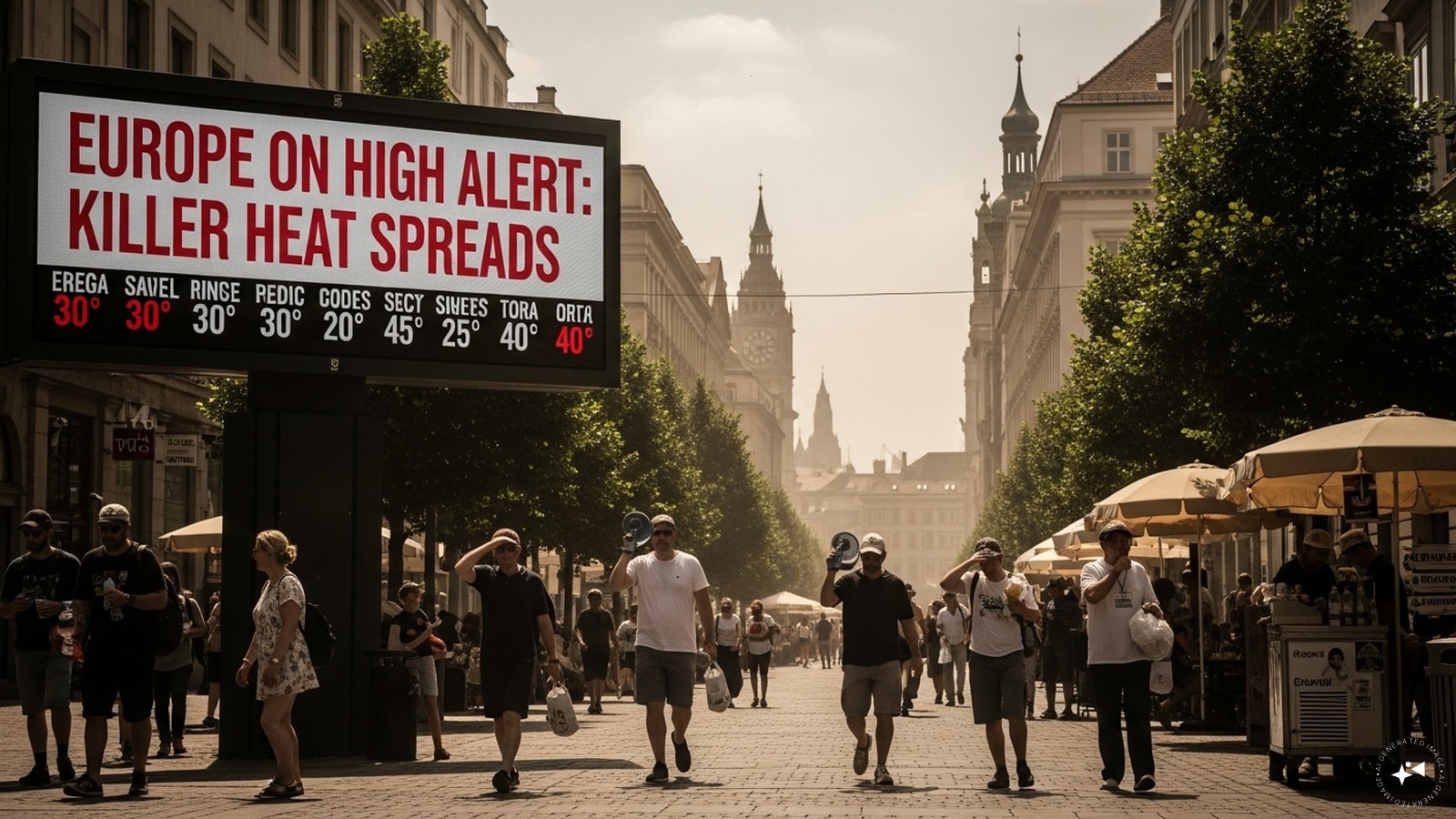
Europe is currently trapped inside a literal furnace. If you think this is just another typical summer heatwave that you can sit out with a cold drink and a fan, you are dead wrong. The news headlines say killer heat spreads across Western Europe, but they don't fully capture the grim reality on the ground right now. This isn't just uncomfortable weather. It is a structural failure of a continent built for a climate that no longer exists.
Right now, health authorities are in emergency mode from London to Belgrade. Paris hit a staggering 40.9 degrees Celsius. The UK broke its June record three days in a row. Roads are fracturing in Germany, and trains are derailing in Sweden. The true crisis isn't just the daytime peak temperatures. It's the fact that European cities cannot shed the heat.
If you want to understand why this specific event is turning deadly so fast, you have to look past the thermometer. The real danger lies in things people rarely consider: 19th-century architecture, failing medical hardware, and a rare atmospheric trap.
The structural trap of European housing
Most people outside Europe ask a simple question. Why can't everyone just turn on the air conditioning?
The answer is simple. They don't have it. Data from the International Energy Agency shows that household ownership of air conditioning in Europe sits at a measly 20 percent. For generations, cooling wasn't a necessity. It was viewed as an American luxury or a wasteful habit that caused sore throats.
Instead, European homes were engineered to do the exact opposite. They are built to capture and retain heat.
Think about the traditional apartment buildings in Paris, Berlin, or London. They feature thick brick walls, heavy masonry, and massive insulation meant to keep residents alive during freezing winters. When temperatures stay above 40 degrees Celsius for days, these buildings turn into brick ovens. They bake in the sun all day. By 9:00 PM, when the sun finally sets, the outside walls are still radiating intense heat directly into the living spaces.
This causes a massive physiological problem. Experts note that when nighttime temperatures fail to drop below 22 degrees Celsius, the human body cannot recover. You don't stop sweating. Your heart rate stays elevated. Your core temperature never resets. This relentless exposure is what drives excess deaths, particularly among older populations and people living in top-floor apartments.
Roads and rails are literally snapping
Our modern world relies on a hidden assumption. We assume the ground beneath us stays solid. This heatwave proves how fragile that assumption is.
When the killer heat spreads down major transit corridors, infrastructure collapses. Take Germany's famous A2 motorway. The extreme heat caused the concrete surface to buckle and rupture across multiple lanes. It didn't just crack. It violently burst upward, damaging 30 vehicles and forcing an immediate closure of a vital shipping artery.
The rail systems are in even worse shape. Steel tracks expand when they get hot. If they expand too much, they twist out of alignment.
- In Sweden, a cargo train derailed because the tracks buckled under the sun.
- In Austria, rail operators are issuing frantic warnings that their entire network is at risk of warping.
- In the UK, the Met Office had to extend its red heat alert into a third consecutive day because the infrastructure simply has no time to cool down.
This creates a terrifying domino effect. You can't run trains to transport fuel. You can't drive trucks on ruptured highways. People are trapped exactly where they are, inside homes that are actively overheating.
Why killer heat spreads into the medical system
Hospitals are supposed to be safe havens during a crisis. Right now, they are struggling to keep their own equipment running.
In the UK, frontline doctors reported that the extreme heat is actively disabling critical medical machinery. High-end diagnostic equipment like MRI scanners and cancer treatment machines require precise cooling systems to operate safely. When the ambient temperature inside a hospital rises too high, these machines automatically shut down to prevent permanent damage. You can't diagnose a stroke or administer radiation when your building is a sauna.
The human toll in the emergency rooms is already devastating. In Paris alone, emergency medical services confirmed 55 deaths within a single 24-hour window. Doctors are openly using words like apocalyptic to describe the conditions.
Because people are desperate to cool down, a secondary crisis has emerged. France reported 40 drowning deaths in just a few days. People are jumping into rivers, canals, and lakes that they don't realize are dangerously deep or full of hidden currents. It's a tragic reminder that panic makes people take fatal risks.
The nightmare of the Omega block
This isn't random bad luck. A specific meteorological phenomenon is holding the continent hostage. Meteorologists call it an Omega block.
Imagine a massive, high-pressure system shaped like the Greek letter $\Omega$. This atmospheric wall traps a massive bulge of hot air over Western Europe, completely blocking the normal flow of cooler ocean winds. The hot air just sits there, cooking the land day after day. Cooler weather is pushed far out to the fringes, leaving the center of the continent to roast.
Climate scientists at the World Weather Attribution group analyzed the data. Their conclusion is stark. This extreme event would be virtually impossible without human-induced climate change. The stifling nighttime temperatures that are killing people right now are 100 times more likely to occur today than they were just twenty years ago.
The worst part? It isn't over. While the heat is starting to ease slightly in parts of Britain and France, the World Meteorological Organization warns that the entire system is shifting. The ball of hot air is rolling east and south. Central Europe and the Balkans are next in the crosshairs. Italy is already bracing for its first weekend of sustained 40-degree weather.
Practical survival steps when your home lacks cooling
If you are stuck in an area hit by this system, you cannot rely on traditional advice. Telling someone to just open a window can actually make their home hotter. You need a tactical plan to keep your living space liveable.
Manage your windows like a fortress
Do not leave your windows open during the day. If the outside air is 38 degrees and your inside air is 28 degrees, opening the window just invites the fire inside. Keep everything shut tight. Close your blinds, curtains, or shutters the moment the sun comes up. You want to create a dark cave. Only open the windows late at night when the outside air finally drops below the indoor temperature.
Create a localized cooling zone
Don't try to cool your entire house. Pick one room, preferably the lowest floor or the room with the least sun exposure. Block the doors with towels. Focus all your efforts there. If you have a portable fan, don't just point it at your face. Place a large bowl of ice or frozen water bottles directly in front of the blades. The fan will pick up the chilled air from the melting ice, creating a rudimentary evaporative cooler.
Hack your body temperature directly
When ambient air is hotter than your skin, a fan alone won't cool you down effectively. It just blows hot air over you. You must use water. Take cool showers, or wrap wet towels around your neck and wrists. Your pulse points are close to the skin in these areas, meaning the water will help lower your core blood temperature much faster.
Rethink your hydration strategy
Drinking ice-cold beer on a hot day sounds amazing. It's also incredibly dangerous right now. French authorities took the drastic step of banning public alcohol consumption for a reason. Alcohol dehydrates you rapidly and impairs your body's natural ability to regulate its temperature. Stick to water with electrolyte powders or sports drinks. You are losing salt through sweat, and drinking plain water in massive quantities without replacing those salts can lead to a dangerous condition called hyponatremia.
Get your elderly neighbors out of upper-floor apartments. Check on people who live alone. The infrastructure is failing, so survival comes down to basic, immediate actions inside your own home. Stay inside during peak hours, keep the sun out, and don't underestimate this heat.