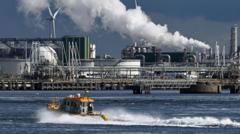
The Port of Rotterdam handles over 400 million tons of cargo every single year. It is a massive, sprawling industrial monster that stretches for forty kilometers across the Dutch coast. It drives the European economy. It also pumps out a staggering amount of carbon, accounting for roughly 13.5% of the total emissions of the Netherlands. Right now, pressure is building on Europe's biggest port to be greener, but the reality on the ground shows a messy, slow-moving conflict between corporate interests and actual climate survival.
People look at Rotterdam and see the future of clean shipping. The marketing promises net-zero emissions and clean hydrogen highways. If you look closer, the actual infrastructure shows a different story. The transition is lagging behind its own targets.
The Illusion of the Clean Hydrogen Hub
For years, the port authority has pushed hydrogen as the silver bullet. They talk about a future powered entirely by green hydrogen generated from offshore North Sea wind. That sounds great on paper. In practice, the numbers do not add up yet.
By 2030, the port wants 2 gigawatts of electrolyzer capacity. That requires an immense amount of renewable electricity that the Dutch grid simply cannot deliver right now. Because green hydrogen is scarce, the port is leaning heavily on blue hydrogen. This relies on natural gas, with the resulting carbon captured and buried under the North Sea.
Experts from environmental research groups like SOMO argue this approach actively extends the lifespan of fossil fuel infrastructure. Instead of cutting off oil and gas, the port is building multi-decade safety nets for the world's biggest oil majors. Four major oil refineries sit inside the port limits. They are not shutting down anytime soon. They are retooling to use blue hydrogen, ensuring they can keep refining for decades under the guise of being eco-friendly.
Shore Power and the Shifting Deadlines
A major issue right now is how ships behave when they are docked. When a massive container ship sits at a quay, it usually keeps its auxiliary diesel engines running to power its onboard systems. This spews toxic sulfur and carbon directly into the local air.
The port recently secured a €90 million loan from the European Investment Bank to install shore-power facilities at three deep-sea container terminals. This project aims to create 35 connection points along eight kilometers of quayside so ships can plug into the local electrical grid instead of burning fuel.
It is a step forward, but the timeline is painfully slow. The installations will not even start operating in phases until the second half of 2028. That means millions of tons of emissions will continue to pollute the surrounding communities for years while the infrastructure slowly crawls into existence. Shipping companies are hesitant to retrofit older vessels with the necessary connection equipment because it costs money, and the port has historically been soft on enforcement.
The Corporate Standoff Over Land Leases
The port authority acts like a landlord. It leases out massive plots of land to chemical plants, coal terminals, and oil companies. This is where the green strategy completely breaks down.
The port authority has repeatedly refused to take direct responsibility for the emissions of its corporate tenants. They claim they cannot legally force these private entities to accelerate their decarbonization timelines without destroying the economic competitiveness of the region. Nearly 400,000 jobs depend on the port complex. Politicians are terrified of driving those companies away to less regulated ports in other parts of the world.
This creates a standoff. The port signs long-term lease renewals with major polluters without tying those leases to strict, legally binding emission reduction targets. Public money from Dutch and European taxpayers is heavily funding things like carbon capture pipelines, effectively subsidizing the cleanup costs for highly profitable oil and chemical giants.
Real Action Items for Global Supply Chains
If you run a logistics business or rely on European shipping hubs, you cannot wait around for Rotterdam to figure out its political issues. You need to protect your own supply chain metrics right now.
- Audit your maritime carriers immediately. Do not accept vague green promises. Demand data on which vessels utilize shore-power capabilities and prioritize booking with fleets that actively plug in when docked.
- Track alternative fuel bunkering metrics. Rotterdam is scaling up its bio-methanol and liquefied natural gas capacity. Bunkering of bio-methanol hit nearly 12,000 tons recently. Shift your freight contracts toward operators using these specific, verified low-carbon fuel allocations.
- Factor regulatory penalties into your financial forecasting. The European Union Green Deal and maritime carbon taxes are getting stricter. Ports that fail to clean up fast enough will face higher compliance costs, and those costs will be passed directly down to your cargo rates.
The pressure to be greener will not disappear. Rotterdam is trying to build a massive infrastructure network while keeping its industrial giants happy, but the slow pace means businesses must take charge of their own carbon footprints rather than waiting for the port to save them.