Astronomers have spent decades looking in the completely wrong place for the oldest star clusters in the cosmos.
For generations, the consensus seemed rock solid. If you wanted to find the nurseries of globular clusters—those massive, tightly packed spheres of up to a million stars that orbit modern galaxies like our Milky Way—you looked deep inside the chaotic, gas-drenched centers of infant galaxies. It made sense on paper. You need an incredible amount of raw material to pack hundreds of thousands of stars into a space only a few light-years across. Naturally, you would assume that only the thick, violent disks of early galaxies had the density to pull it off.
Except the math never quite lined up.
When you look at modern globular clusters, they don't behave like they were forged in the fires of a spinning galactic disk. They are remarkably stable, quiet, and low-rotation objects. If they had been born in the fast-spinning, turbulent centers of early galaxies, they should have inherited that spin. Instead, they act like cosmic wallflowers.
A fascinating study offers an elegant answer to this long-standing puzzle. The paper, bluntly titled "Too shy to spin? Cosmic wallflowers as proto-globular clusters," flips the script entirely. Led by astrophysicists Floor van Donkelaar, Lucio Mayer, and Pedro R. Capelo, the research suggests that the oldest star clusters did not form inside early galaxies at all.
They formed out in the quiet suburbs.
The Trouble With Galactic Disks
To understand why this is a massive shift in perspective, we have to look at how brutal the early universe was. About 13 billion years ago, during the dawn of galaxy formation, everything was a mess. Galaxies were pulling in immense amounts of gas, merging with each other, and lighting up with intense bursts of star formation.
Astronomers assumed that globular clusters were the natural product of this inner galactic chaos. The idea was that immense pressures within galactic disks squeezed gas clouds into hyper-dense pockets.
But this conventional model runs into a severe survival problem.
Galactic disks are dangerous neighborhoods. They are filled with massive gravitational tidal forces, shockwaves from supernovae, and constant structural disruptions. A young star cluster trying to hold itself together inside a spinning disk faces an uphill battle. The high rotational energy it inherits from the disk actually makes it easier to tear apart. Tidal shocks from passing gas clouds can systematically strip stars away, dissolving the cluster into the general galactic background.
Most clusters born in the disk simply don't survive. They get shredded.
Tracking the Cosmic Wallflowers
The research team used the MassiveBlackPS simulation, a high-resolution cosmological framework designed to model the physics of the early universe at redshifts around $z \sim 7.6$. This is a period less than a billion years after the Big Bang.
Instead of just looking at the main bodies of the simulated galaxies, the team paid close attention to the circumgalactic medium. This is the relatively empty space surrounding the young galaxies, filled with long, dense filaments of gas flowing inward from the broader cosmic web. Think of these filaments as pipelines feeding the hungry, growing galaxies.
The simulation revealed something unexpected. As pristine gas traveled along these cold filaments toward the galaxies, the streams occasionally became gravitationally unstable.
They started to fragment.
Without the shearing forces and rapid rotation of a galactic disk, these collapsing gas fragments didn't spin up into a frenzy. They just collapsed directly, rapidly, and cleanly.
The result? The simulation produced dozens of ultra-compact star clusters sitting out in the middle of nowhere, well outside the main galactic bodies but still trapped within the broader dark matter halos. The researchers called these isolated systems "cosmic wallflowers."
Because they formed in a quiet environment, these wallflowers had very low rotational velocities ($v_{\rm rot}$) relative to their internal velocity dispersion ($\sigma$). They were dense, heavy, and crucially, they weren't spinning wildly.
Decoding the Rotational Fingerprint
The core breakthrough of this new model comes down to a specific mathematical ratio: $v/\sigma$. This measures the balance between a cluster's rotation and the random velocity of its individual stars.
When the researchers plotted the properties of their simulated clusters, a stark divide emerged:
- Disk Clusters: Systems that formed inside the main galactic disk showed high rotational velocities. They were strongly rotation-dominated.
- Cosmic Wallflowers: Systems that formed in the filamentary outskirts had exceptionally low rotation. They relied on random stellar motion to support themselves against gravity.
When you look at the actual globular clusters orbiting the Milky Way today, their physical properties align with the wallflowers. The disk-born clusters in the simulation remain completely offset from reality; they spin far too fast to match what we observe in the modern universe.
The low-rotation, gas-rich cosmic wallflowers provide an identical match.
This environment also explains how they survived for 13 billion years. By forming out in the quiet circumgalactic zones, these clusters escaped the violent tidal forces that cleared out their disk-born siblings. Over billions of years, as their host galaxies grew and merged, these isolated clusters were slowly swept up, settling into the extended spherical halos where we see them today. They are survivors precisely because they started their lives in hiding.
The James Webb Space Telescope Connection
This isn't just a neat computer simulation. Real-world observations are starting to back it up.
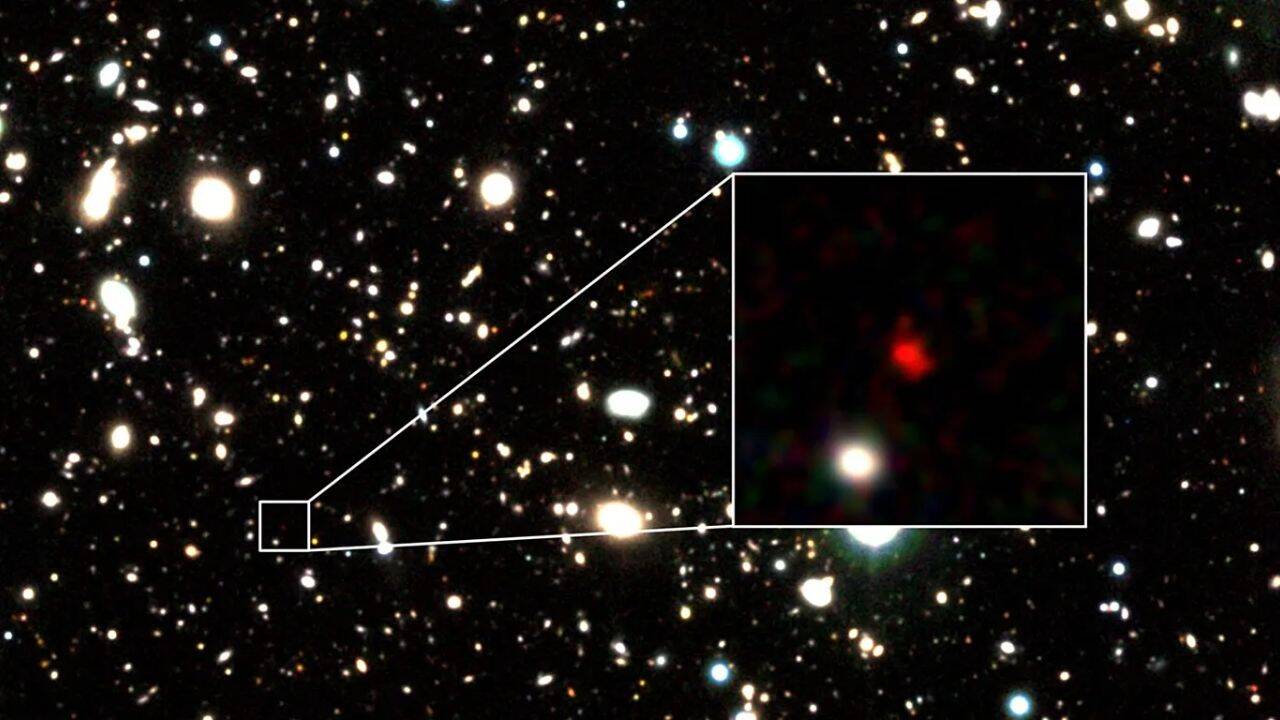
Recently, an international team led by Angela Adamo utilized the James Webb Space Telescope (JWST) to peer back to just 460 million years after the Big Bang. They targeted an object known as the Cosmic Gems arc (SPT0615-JD1). This is an incredibly distant infant galaxy whose light has been magnified nearly a hundred times by a foreground cosmic magnifying glass—a phenomenon called gravitational lensing.
When the JWST data came in, astronomers were stunned to see a string of five distinct, ultra-dense dots mirrored across the arc.
Those dots are proto-globular clusters.
What shocked scientists was just how dense and isolated they appeared. They are significantly smaller and up to three orders of magnitude denser than any star clusters we see in nearby modern galaxies. The surface densities inferred from these real-world "gems" match the properties of the simulated cosmic wallflowers.
While the JWST data cannot directly measure the rotation of those tiny dots just yet, the physical scales and densities perfectly mirror what the MassiveBlackPS simulation predicts for clusters forming along circumgalactic gas streams. The timeline matches. The densities match. The isolation matches.
The Alternate Path to Black Holes
The study does hint at a split destination for these early systems. Not every cosmic wallflower turns into a quiet globular cluster.
Within the simulated wallflower population, the researchers identified two distinct evolutionary pathways determined by how much gas the cluster managed to hold onto:
- The Low-Density, Gas-Rich Pathway: These systems maintain low rotation and evolve directly into the classic globular clusters we see today.
- The High-Density, High-Rotation Pathway: Some wallflowers accumulate so much mass so quickly that they begin to spin up and collapse internally.
This second group is fascinating for a different reason. The extreme density at their centers can trigger runaway stellar collisions. Stars bump into each other, merge, and rapidly collapse into intermediate-mass black holes. These dense clusters might actually serve as the missing seeds required to grow the supermassive black holes that sit at the centers of modern galaxies.
This means the circumgalactic medium wasn't just a nursery for old stars. It was likely the birthplace of cosmic monsters.
Mapping the Next Steps
If you want to follow how this rewrite of cosmic history develops, the next few years will be telling. The debate between disk formation and circumgalactic formation is far from settled, but the momentum is shifting.
You can look out for specific milestones as the astronomical community tests this new theory:
- Keep an eye on JWST spectroscopic updates: Astronomers are currently working on extracting rotational dynamics from lensed galaxies in the early universe. If upcoming data confirms that early compact clusters lack strong rotational support, the disk-formation model will face a tough road ahead.
- Track the 2026 and 2027 lensing surveys: New observing programs targeting massive galaxy clusters as gravitational lenses are scheduled. These will search for more variations of the Cosmic Gems arc to see if isolated proto-clusters are the rule or the exception.
- Watch for chemical abundance studies: Globular clusters have weird chemical anomalies, like varying amounts of sodium and oxygen among stars in the same cluster. Keep tabs on high-resolution stellar surveys of the Milky Way halo; mapping these anomalies against simulation data will reveal whether a cluster's chemistry points to a pristine filament or a polluted galactic disk.
The idea that the universe’s most enduring stellar structures were born as outcasts in the dark outskirts of space changes the way we view the cosmic web. They weren't born in the chaos of the city. They were raised in the quiet countryside, waiting for the rest of the universe to catch up.

:max_bytes(150000):strip_icc()/umiz003-58b8df575f9b58af5c90102d.jpg)