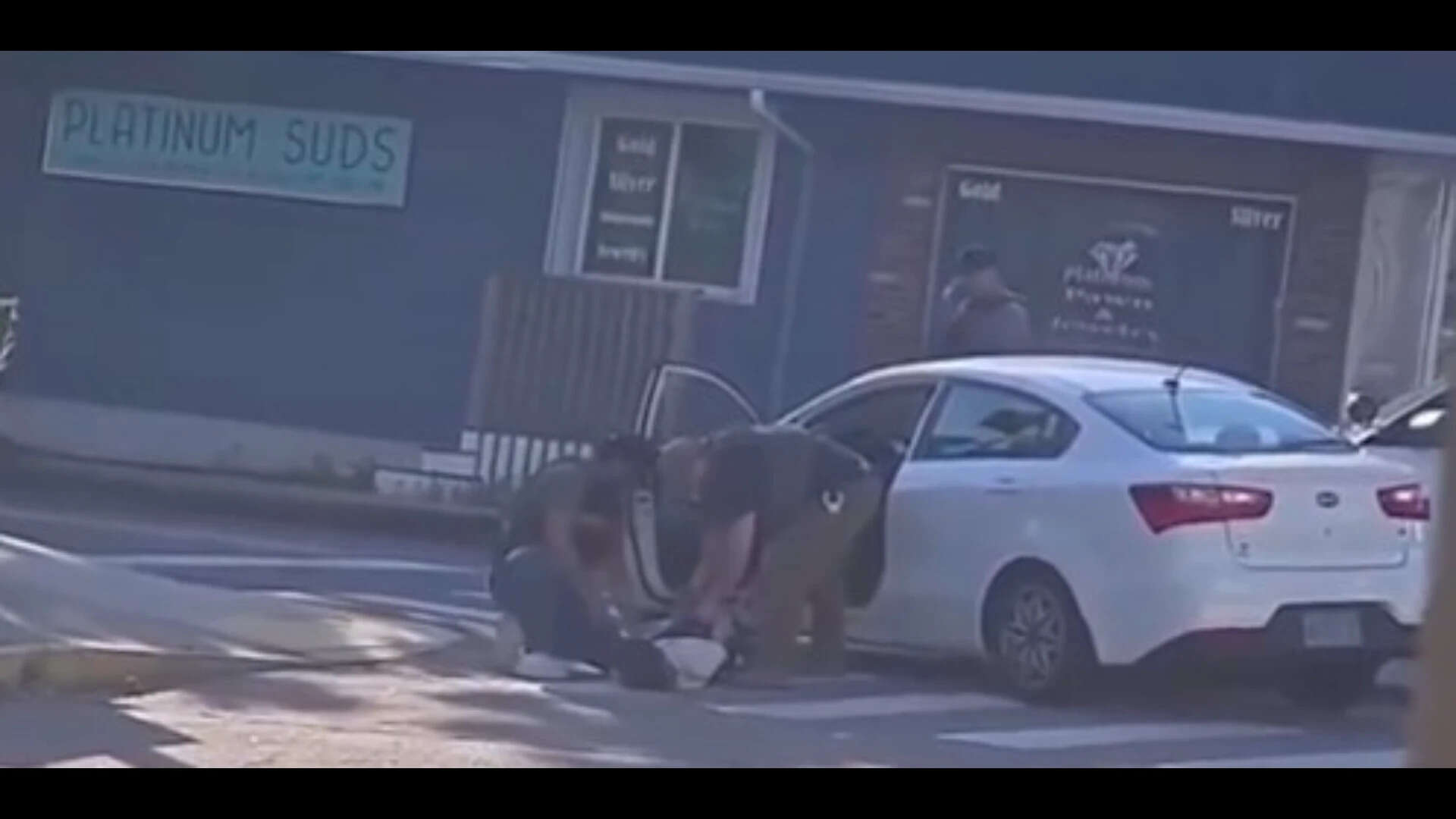
A quiet morning in Biddeford, Maine, shattered into chaos when federal immigration agents pulled the trigger on a 26-year-old Colombian worker. The aftermath looked like a war zone. Bullet holes riddled the windshield of a white Kia sedan. A young man lay on the pavement, bleeding profusely from his head. His final, desperate words to a nearby witness were raw and heartbreaking: "I tried to stop".
This wasn't a high-profile raid on a dangerous cartel operative. It was a routine Monday morning operation by Immigration and Customs Enforcement (ICE) that turned fatal. It happened in a coastal city of 23,000 people, far from the southern border. The victim possessed a valid Social Security number and legal authorization to work in the United States. He was heading out to his job to provide for his wife and young daughter.
He wasn't even the person ICE agents were looking for.
The tragedy highlights a terrifying reality for millions of immigrant workers across the country. You can play by every rule available, file your paperwork, secure a tax-paying job, and still end up dead on an intersection because an agent mistook your car or panicked during a routine surveillance operation. The official narrative collapsed within hours, exposing a systemic pattern of unaccountable aggression that should alarm every worker in America, regardless of their immigration status.
The Chaotic Morning in Biddeford
Around 7:20 AM, Enforcement and Removal Operations (ERO) agents set up surveillance outside a residential home in Biddeford. They were allegedly hunting for an undocumented individual with a final order of removal. When a white Kia sedan pulled out of the property, the agents moved in.
What happened next depends entirely on who you ask, but the official story shifted fast.
Initial statements pushed by the Department of Homeland Security (DHS) claimed the driver attempted to flee and "weaponized" his vehicle against the officers. Maine Senator Angus King stated that Homeland Security Secretary Markwayne Mullin personally told him the agent opened fire because the motorist tried to use the car as a weapon. That's the standard script federal agencies deploy whenever an officer-involved shooting occurs. It builds an immediate defense of justifiable self-defense.
Witnesses on the ground saw a completely different reality.
Daniel Boucher was getting ready for work when he heard what sounded like fireworks. He rushed to the window and saw a chaotic scramble. Federal agents in vests swarmed the intersection, trying to stop the white car. An ICE SUV rammed the sedan to halt its movement. Boucher watched agents drag the young driver out of the vehicle. The man was bleeding from a severe head wound, yet he was still conscious enough to speak. He didn't sound like someone who had aggressively weaponized a vehicle. He was terrified, telling the agents he tried to stop before he finally lost consciousness and stopped breathing.
Another local witness, Corey Poulin, noted that security footage from his family's nearby laundromat showed the car rolling helplessly into the intersection after the shots were already fired. The driver was likely incapacitated or dead behind the wheel while the car circled out of control. The Maine State Police immediately stepped in and requested that the business owner withhold the footage from the public.
By Monday afternoon, the federal narrative fell apart. Senator King was forced to issue a stunning correction to his earlier press statements. DHS admitted that the 26-year-old Colombian worker was not the target listed on their arrest warrant. He was just a guy leaving his house for work, caught in the crosshairs of an aggressive, unmonitored federal force.
When a Work Permit and Social Security Number Offer Zero Protection
A massive point of confusion for many observers is how someone can have a Social Security number, valid work authorization, and still face a deportation apparatus. The general public often thinks immigration is a binary system: you're either completely documented or completely undocumented. That's entirely wrong.
Millions of people live in a legal gray zone. Individuals with pending asylum claims, temporary protected status, or those navigating complex adjustment tracks often receive an Employment Authorization Document (EAD) and a legitimate Social Security number. They pay taxes, open bank accounts, buy cars, and build families.
A work permit doesn't automatically wipe away an underlying immigration case or an old administrative removal order issued by a fast-tracked immigration court. ICE regularly capitalizes on this legal vulnerability. The agency treats administrative paperwork violations with the same tactical aggression reserved for violent criminals.
The Colombian immigrant killed in Biddeford did exactly what society asks of newcomers. He secured a job, integrated into his neighborhood, and drove a registered vehicle. Local advocacy groups like the Maine Immigrants' Rights Coalition and Presente! Maine expressed deep outrage because this case proves that compliance provides no safety. When federal agents approach an interaction with tactical gear and weapons drawn, your tax status or your employment paperwork won't stop a bullet.
The Shift from Targeted Operatives to Collateral Victims
The Biddeford tragedy isn't an isolated mishap. It highlights a dangerous operational shift under aggressive federal immigration mandates. ICE operations have increasingly relied on sweeping surveillance and broad enforcement tactics that view anyone in the vicinity of a target as fair game.
When agents conduct "targeted surveillance," they frequently pull over vehicles based on loose descriptions, racial profiling, or pure proximity to a tracked address. If an individual panics—perhaps because they are being swarmed by unmarked SUVs and plainclothes individuals with drawn weapons—the situation escalates instantly.
Legal experts and law enforcement veterans have argued for decades that officers should never place themselves directly in front of a moving vehicle to justify firing shots. Yet, ICE agents routinely initiate high-stress stops in tight residential neighborhoods, creating scenarios where a driver's natural reaction to flee or avoid an unmarked vehicle is interpreted as a deadly threat.
Consider the sheer terror of the situation. You leave your house at dawn. Unmarked vehicles block your path. People without obvious police uniforms shout conflicting orders. In a split second, you try to maneuver away, and an agent opens fire through your windshield. That isn't a targeted immigration system. That's a structural recipe for disaster.
Body Cameras and the Wall of Silence
The investigation into the Maine shooting faces a massive hurdle that has plagued civil rights advocates for years: a complete lack of objective video evidence. Senator King confirmed that the ICE agents involved in the Biddeford shooting were not wearing body-worn cameras.
Think about that for a second. Local police forces in tiny towns across America are required to wear body cameras to ensure accountability. Yet, federal agents endowed with the authority to use deadly force and deport human beings operate entirely in the dark.
This lack of transparency allows the agency to control the narrative immediately after a tragedy occurs. They can claim a vehicle was "weaponized" without fearing immediate contradiction from official footage. They rely on the fact that local surveillance cameras might not catch the entire interaction, or that local authorities will suppress private footage during the active investigation.
The FBI and the Maine Attorney General's office are currently investigating the shooting. History shows that federal investigations into federal law enforcement actions rarely result in meaningful criminal accountability for the agents involved. Without body camera footage, the case boils down to the word of a distraught agent vs. the dying words of a migrant worker who can no longer defend himself.
A Pattern of Deadly Force Across the Country
If you think the Biddeford shooting was a freak occurrence, you haven't been paying attention to the news. This fatal encounter marked the second time in a single week that ICE agents used deadly force on an immigrant worker.
Just six days prior to the Maine incident, an ICE agent shot and killed Lorenzo Salgado Araujo in Houston, Texas. The similarities between the two cases are horrifying:
- The Targets: In Houston, just like in Maine, ICE was looking for someone else. Salgado Araujo wasn't the target of the operation; he merely resembled the individual they were seeking.
- The Justification: ICE claimed Salgado Araujo rammed a law enforcement vehicle and tried to run over an officer. Witnesses who were actually in the vehicle with him explicitly denied that claim, stating he never weaponized his van.
- The Background: Salgado Araujo had lived in the U.S. for over three decades, ran a construction business, raised three kids, and was actively in the process of securing his work permit.
- The Blackout: The agents in the Houston shooting were also completely devoid of body cameras.
When the exact same scenario plays out on opposite ends of the country within a six-day window, you aren't looking at isolated incidents of poor judgment. You're looking at a structural feature of an enforcement system that operates with absolute impunity and zero transparency.
Actionable Steps for Immigrant Workers and Communities
Grieving and feeling furious is completely justified, but communities need concrete strategies to navigate this hostile environment. If you or your loved ones hold temporary status, a work permit, or are currently navigating an open immigration case, relying on your paperwork for safety isn't enough. You must understand your rights during unexpected encounters with federal agents.
Know How to Handle Unmarked Stops
ICE agents frequently operate in unmarked vehicles and wear vests that simply say "Police" or "ICE". If you are pulled over or boxed in by an unmarked vehicle, do not make sudden movements. Keep your hands clearly visible on the steering wheel. Sudden acceleration or trying to squeeze past an unmarked SUV can be instantly interpreted as an attempt to use your vehicle as a weapon.
Record Everything Safely
You have a clear, constitutionally protected right to record law enforcement officers operating in public spaces. If you see an ICE interaction happening in your neighborhood, pull out your phone and record it safely from a distance. As the cases in Maine and Texas prove, bystander video and local security footage are often the only tools capable of breaking through the official narrative manufactured by federal agencies.
Document Your Rights on the Road
Keep a physical copy of your employment authorization card, driver's license, and any pending immigration receipts in your vehicle's glove compartment. Never present fraudulent documentation. If agents ask to search your vehicle or your home, you have the right to remain silent and refuse consent unless they present a judicial warrant signed by a court judge. Administrative ICE warrants (Forms I-200 and I-205) do not give agents the legal authority to enter your private property or search your vehicle without your explicit permission.
Connect with Rapid Response Networks
Local advocacy groups run active hotlines to report immigration enforcement activity. In Maine, the Immigrant Defense Hotline was flooded with calls immediately following the Biddeford shooting. Find the rapid response network in your city, save their number in your phone, and make sure your family members know who to call if an emergency occurs. Legal representation must be engaged immediately following any detention or enforcement action.
The reality is stark. A 26-year-old man came to this country, worked legally, built a life, and was shot in the head during a botched operation meant for someone else. The myth that compliance protects you from state violence has been completely destroyed. Relying on a broken system to fix itself is a losing strategy. Communities must organize, record every interaction, and understand the raw reality of their legal rights on the street.