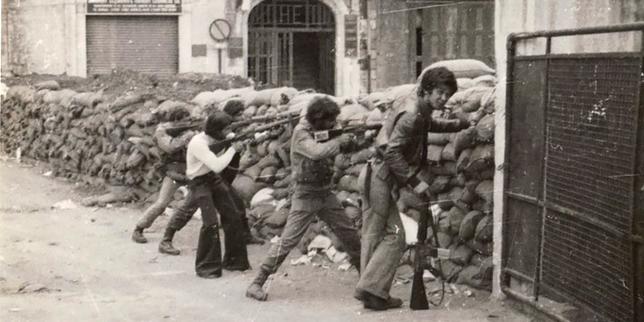
In the spring of 1976, a bizarre and brutal migration began from the university halls of Paris to the smoking ruins of Beirut. Young French nationalists packed their bags, grabbed false passports, and headed East. They weren't looking for tourism. They wanted a war. They found it in the Lebanese Civil War, joining Christian militias to shoot at Palestinian and leftist fighters.
History books usually ignore these guys. They get brushed off as temporary anomalies or standard mercenaries. But if you want to understand how the European far right shifted from post-colonial bitterness to a modern obsession with a clash of civilizations, you have to look at what happened in Beirut fifty years ago.
It wasn't a random adventure. It was a calculated, ideological deployment that set the template for modern foreign fighter networks.
The Myth of the New Crusade
By 1976, the French far right was hurting. The loss of French Algeria in 1962 still stung like a fresh wound. Militants from groups like the GUD (Groupe Union Défense) and the PFN (Parti des Forces Nouvelles) felt completely alienated in post-May 68 France. They despised communism, hated gaullism, and felt their own country had grown soft and decadent.
Lebanon changed everything for them. When the civil war erupted in 1975, pitting the Christian-dominated Maronite militias against the Palestine Liberation Organization (PLO) and Lebanese leftist factions, French extremists saw a perfect ideological mirror.
They didn't see a complex Middle Eastern political struggle. They saw a holy war. They convinced themselves that Beirut was the front line of defense for Western civilization against Marxist-Islamist expansion.
Pierre Gemayel’s Kataeb Party, better known as the Phalangists, became their hosts. The Phalangists were highly organized, fiercely anti-communist, and structured along lines that felt comfortably familiar to European fascists. For a young Parisian militant who spent his weekends pasting posters and getting into street fights with leftist students, the chance to handle real assault rifles in a real war was intoxicating.
Sending the Shock Troops East
The logistics behind this pipeline were surprisingly organized. It wasn't just individual adventurers slipping through the cracks. Right-wing networks in Paris actively recruited, funded, and funneled these volunteers.
Figures associated with the old OAS (Organisation Armée Secrète) and newer extremist factions used their connections to arrange travel. They flew into Cyprus, then took clandestine boats to the Christian-controlled ports of Jounieh or East Beirut.
Once they arrived, the reality hit them fast. This wasn't a clean ideological crusade. It was filthy, urban guerrilla warfare.
The French volunteers were integrated into specialized units within the Phalangist forces or the Tigers Militia of the National Liberal Party. They fought in some of the bloodiest engagements of 1976, including the infamous Siege of Tel al-Zaatar, a Palestinian refugee camp that turned into a months-long slaughterhouse.
They brought French military tactics, often learned from older veterans of the Indochina and Algeria wars. They also brought absolute ruthlessness. To them, every enemy fighter was a stand-in for the Algerian FLN or the Soviet Red Army.
Why the Experiment Collapsed
The romance didn't last long. The illusion of a grand brotherhood of Western defenders fell apart under the weight of Lebanese reality.
French volunteers quickly realized they were pawns in a factional power struggle they didn't fully understand. The Christian militias weren't fighting for European civilization; they were fighting for their own survival, political dominance, and sectarian territory.
Language barriers, cultural friction, and different tactical priorities created immediate tension. The Lebanese commanders didn't want ideological theorists from Paris lecturing them on political philosophy. They wanted warm bodies to hold barricades and clear rooms.
Then came the body bags. Dozens of French volunteers were killed or permanently maimed in the streets of Beirut. When Syria intervened in the conflict later in 1976, completely shifting the alliances and turning the war into an even more complicated regional quagmire, most of the French survivors realized they were out of their depth.
The money ran out. The political support back home fractured. By late 1977, the pipeline had dried up, leaving behind a trail of unmarked graves in Lebanon and a group of deeply traumatized, radicalized veterans returning to France.
The Long Shadow over Modern Politics
So why does this obscure footnote from 1976 matter now? Because it changed the DNA of European extremism.
Before Lebanon, the French far right was mostly obsessed with domestic grievances, historical nostalgia, and losing colonial empires. Beirut gave them a global framework. It taught them how to look at geopolitical conflicts through a racial and religious lens, framing every local struggle as part of a massive, global war between Islam and the West.
The tactics they used to recruit and transport fighters became a blueprint. We saw the exact same dynamics play out decades later when European extremists traveled to fight in the Balkans during the 1990s, or more recently, when foreign volunteers rushed to eastern Ukraine. The ideological justification remains almost identical.
It also created a network of battle-hardened radicals who returned to France and entered mainstream nationalist politics. They used their status as combat veterans to gain authority within the National Front and other rising movements, injecting a harder, more militant edge into the political mainstream.
How to Trace the Historical Records
If you want to look into this history yourself without relying on watered-down summaries, you need to know where to dig. Standard history textbooks won't help you much here.
Start by looking at the archived publications of the French extreme right from the mid-1970s, specifically magazines like Initiative Nationale or the student pamphlets distributed around the Assas law faculty in Paris during that era. These documents contain the actual recruitment appeals and idealized frontline reports sent back from Beirut.
For a more objective view, check the French diplomatic archives from 1976, which detail the growing panic in Paris as embassy officials realized dozens of French citizens were actively participating in the destruction of a sovereign state. The memoirs of former Phalangist commanders also offer a blunt, often unglamorous perspective on how little they actually valued their erratic European allies.
Analyze these sources critically. Compare the grandiose ideological rhetoric published in Paris with the grim reality of the casualty reports from the ground in Lebanon. That's where the real story lives.