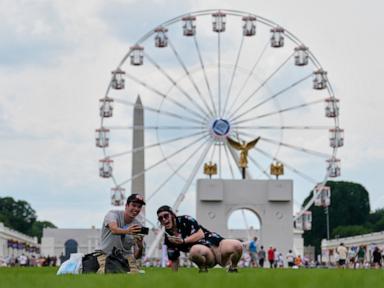
Walk onto the National Mall right now and you will spot a 110-foot Ferris wheel slicing into the Washington sky. Nearby, a replica of an Apatosaurus dinosaur rib cage sits inside a structure built to mimic the neoclassical architecture of the National Gallery of Art. There is a 7,000-pound sandcastle made entirely from Jersey Shore sand, some bleating West Virginia sheep, and a space capsule from Texas.
This is the Great American State Fair, the flagship event kicked off by Freedom 250 to mark the nation’s 250th anniversary. It sounds like an incredible celebration of Americana. But walk past the security gates and you will notice something else.
The crowds are thin. The spaces are empty. The tension is thick.
What was supposed to be a nonpartisan showcase of state pride and cultural history has instead turned into a stark reminder of America's deep political fractures. When an event meant to celebrate national history turns into a turf war over who gets to define patriotism, unity gets left behind.
The Battle of Two Anniversaries
The underlying issue with the Great American State Fair is not the livestock or the exhibits. It is the organization running it.
The event is managed by Freedom 250, an entity created by President Donald Trump to direct his administration's official celebratory events. The problem? Congress already created a group called America250 years ago to plan the exact same semi-quincentennial milestone.
Instead of a single, coordinated national party, the country got competing factions. The dueling organizations created administrative friction and forced local governments to choose sides.
For everyday folks visiting the National Mall, the political undertone is hard to ignore. A smaller decorative arch at the entrance, mimicking the design style used at previous Trump administration events, immediately sets a partisan tone. Some visitors have openly remarked that the design feels less like a traditional American folk festival and more like an institutional propaganda display.
The Empty Booths of the National Mall
If you want to see how fractured the country is, just look at the fair's layout. A state fair requires states to actually show up. Many simply didn't.
Maine, Massachusetts, and Pennsylvania completely opted out of sending delegations to Washington. State officials blamed the decisions on high travel costs, difficult scheduling, and concerns over the event's heavy politicization.
The states that did show up tried their best to treat the fair as a standard tourism opportunity. Arizona drew a steady line of people with an interactive display showcasing its desert terrain. South Carolina set up a putting green. Virginia highlighted its foundational role in colonial history, and the District of Columbia offered a cherry blossom tree and a giant banner for visitors to sign.
Yet even among the participants, the energy feels uneven. The exhibits for Alaska and Hawaii sat completely unstaffed. In the Hawaii booth, the only signs of life were two empty rocking chairs. Tired tourists used them to take a break, sitting under a banner for a state that didn't bother sending a single human representative to speak for it.
Forced Patriotism vs. Genuine Pride
It is an underwhelming reality for families who traveled across the country expecting something grand. Visitors have noted the stark contrast between this event and the 1976 Bicentennial, which left a lasting legacy of genuine communal pride.
The people attending the fair are not angry; they are mostly disappointed. They want to celebrate their shared identity without a political lens. Parents from Ohio or tourists from New York all voice the same basic desire for a simple, nonpartisan celebration.
Instead, the event feels forced. When half the country decides to skip a national birthday party because they dislike the person hosting it, the event ceases to be a celebration. It becomes a statement of separation.
If you are planning to visit the National Mall before the fair wraps up in July, manage your expectations. Go for the West Virginia livestock, the impressive Jersey sandcastles, and the Montana dinosaur fossils. Enjoy the individual pieces of cultural heritage that the state workers and volunteers worked hard to bring to Washington. But do not expect to find a renewed sense of national harmony under the Ferris wheel.
The Great American State Fair proves that in 2026, you can easily gather 7,000 pounds of coastal sand or a replica dinosaur skeleton in the capital. Gathering fifty unified states under one tent is a much harder task.