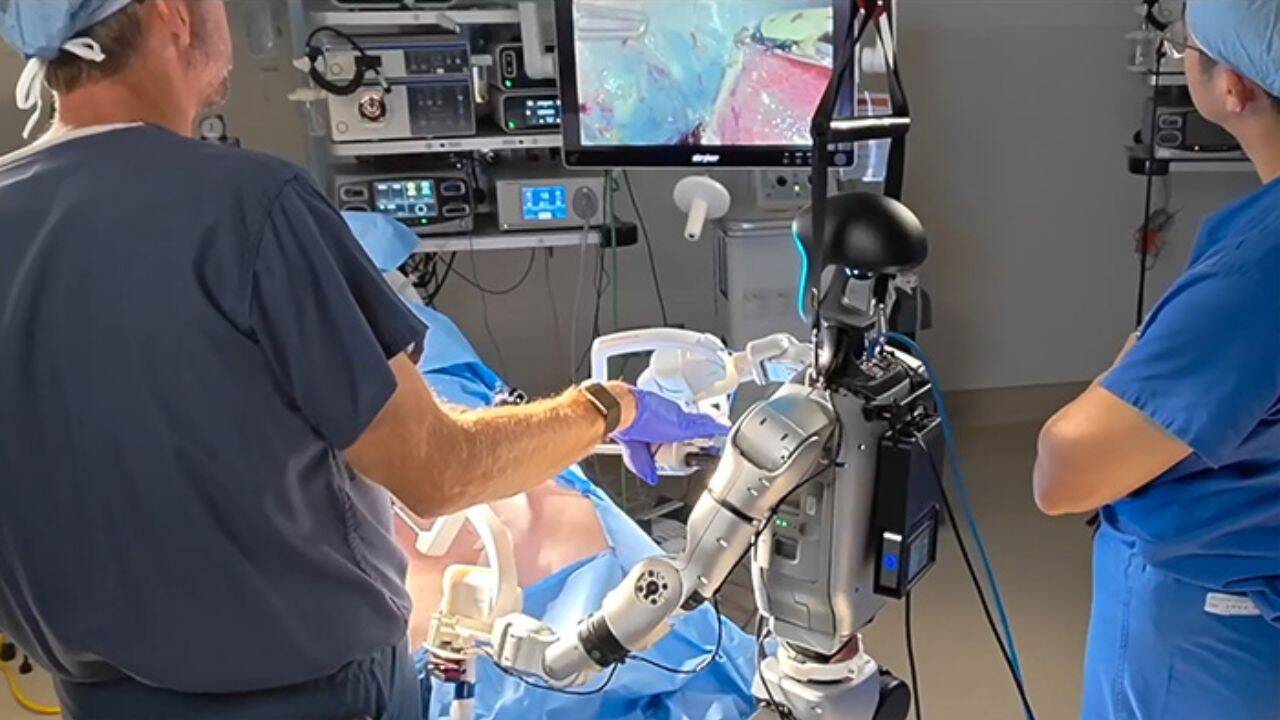
Two human-shaped machines just reached into a living animal and removed an organ. This wasn't a computer simulation or a scripted tech demo. It happened inside a research lab in California, and it marks a radical shift in how we think about medical tech.
Researchers at the University of California San Diego just published a study in Nature showing that teleoperated humanoid robots can successfully perform live surgery on living subjects. The team used these general-purpose machines to complete two separate gallbladder removals on large mammals. In one trial, a robot worked alongside a human surgeon. In the next, two robots worked side by side as a team.
Most people hear about robotic surgery and think of the massive systems already sitting in modern hospitals. This is completely different. This wasn't a multi-million dollar machine built specifically for one medical task. It was a mass-market, general-purpose humanoid adapted for the operating table. It changes the entire economics of modern healthcare.
The Machine Nicknamed Surgie
Hospitals already use robots. If you've had a minimally invasive procedure recently, a machine like Intuitive's da Vinci system might have done the heavy lifting. But those platforms are massive. They weigh around 1,800 pounds, require retrofitted rooms, and lock hospitals into proprietary ecosystems with custom tools.
The UC San Diego team took the opposite path. They utilized a modified Unitree G1, a general-purpose humanoid standing five feet tall and weighing just 60 pounds. They nicknamed it Surgie.
Instead of designing a new surgical instrument from scratch, engineers built physical adapters. These allowed Surgie to grip the exact same standard laparoscopic tools that human surgeons use every day. Dr. Nikita Thareja, a general surgery resident involved in the study, noted how easily the machine meshed into the existing workspace. You don't need a special room for it. You just wheel it in.
How the Live Procedures Worked
The preclinical trials focused on laparoscopic cholecystectomy, which is the standard procedure for removing a gallbladder through small incisions. The robots didn't think for themselves. Human surgeons controlled every single movement from a nearby console using a remote teleoperation interface.
- The Human-Robot Team: In the first operation, one humanoid robot handled the primary tools while a human surgeon acted as the assistant, clearing the field of view and managing secondary tasks.
- The Robot-Robot Team: The second operation removed the human assistant entirely. Two Surgie robots worked side by side, managing multiple laparoscopic instruments simultaneously to complete the organ removal.
Both operations succeeded. The live tissues were handled safely, and the procedures were completed from start to finish. This proves that a general-purpose robot body has the inherent mechanics to handle high-precision medical tasks.
The Massive Financial Disruption
Medical hardware is notoriously overpriced. A high-end traditional surgical platform easily costs between $500,000 and several million dollars. That price tag keeps advanced surgical care out of rural clinics, field hospitals, and developing countries.
Surgie changes that math completely. The base model of the Unitree G1 starts at roughly $13,500. Even when you upgrade it with the advanced, highly dexterous hands needed for delicate medical tasks, the total cost hovers around $67,000.
That is an astonishing drop in price. It means a small rural clinic could theoretically afford the hardware required to host a world-class remote specialist. Dr. Shanglei Liu, who operated the robot during the study, pointed out that because the system takes up a fraction of the space and cost, it can go where traditional robots can't. Think battlefields, remote islands, or even space missions.
The Problems Nobody Wants to Talk About
Don't expect a humanoid to operate on you next Tuesday. The Nature study proved the concept works, but it also exposed massive engineering hurdles that need fixing.
The biggest issue was time. The procedures took significantly longer than standard surgeries because the robots had to be recalibrated multiple times mid-operation. If a robot loses its spatial alignment while holding a scalpel inside a living body, everything stops until it resets.
Then there's latency. When a surgeon moves their hands at the console, the robot needs to mimic that movement instantly. A delay of even a few milliseconds can be dangerous. Right now, the system works well when the surgeon is in the same room. But if we want a specialist in New York operating on a soldier in a field hospital overseas, the data delay caused by long-distance networks is still too high.
This isn't unprecedented, though. The very first human laparoscopic surgeries decades ago took up to six hours. Today, doctors finish them in 30 minutes. The software will catch up.
What Happens Next
The long-term goal isn't just remote control. The researchers are already working toward creating an autonomous surgical assistant.
Because Surgie has legs and human proportions, it isn't confined to the operating table. Future versions could walk around the room, fetch tools from sterile packaging, and clean up the space after a procedure. This addresses the severe staffing shortages plaguing hospitals worldwide.
If you want to track this technology as it matures, keep your eyes on these specific milestones over the next few years:
- Watch the GitHub Documentation: The research team hosts their technical data publicly at
humanoid-surgeon.github.io. Track their updates on software latency fixes. - Look for Multi-Hospital Trials: Before humans are involved, these robots must show consistency across different animal models and varied operating environments.
- Monitor AI Autonomy Updates: Watch for software updates where the robot takes over minor, repetitive tasks on its own, like holding a camera steady or suturing a simple incision, while the human surgeon watches.
Humanoid robots in medicine are no longer science fiction. The hardware is ready, the costs are plunging, and the first successful live surgeries are officially in the books.