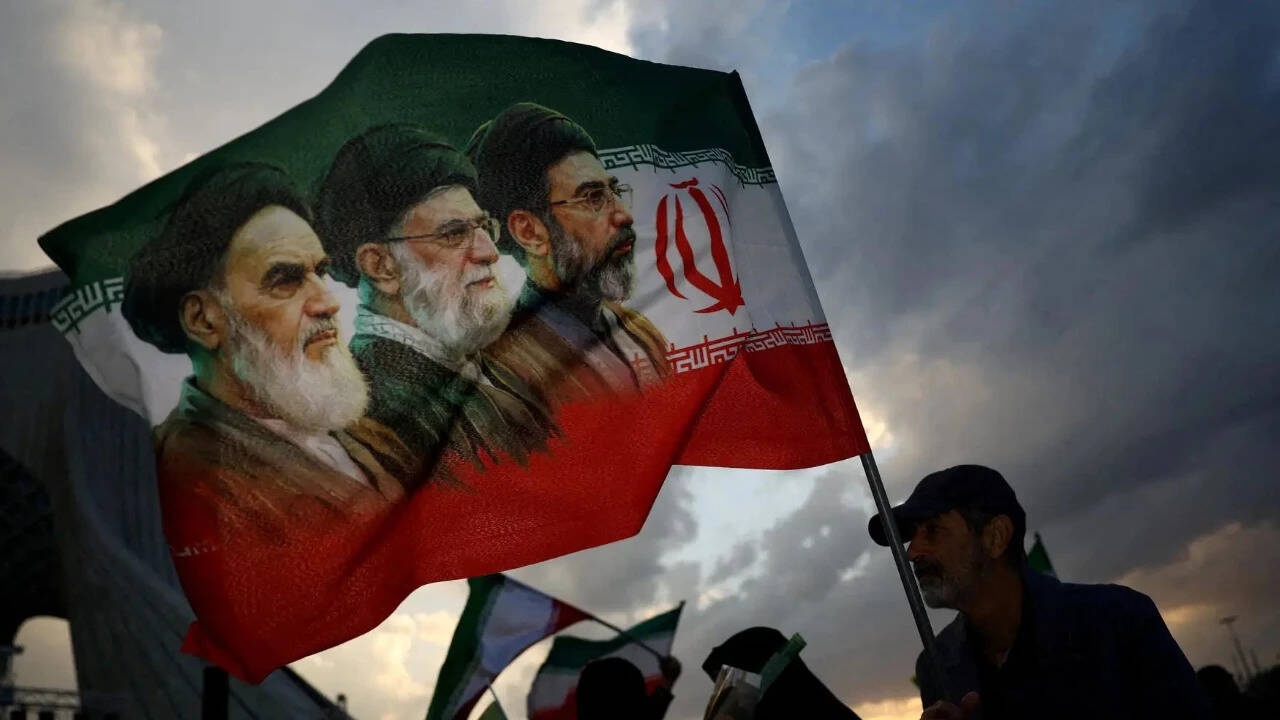
You can't run a theocracy from a bunker. Or, apparently, from outside the country entirely.
Ever since Mojtaba Khamenei took over as Iran's supreme leader following the February 28 airstrikes that killed his father, Ali Khamenei, he hasn't been seen in public. Not once. He skipped the massive, multi-day funeral processions for his own father. He vanished from state television. Now, an explosive security report claims he isn't even in Iran anymore.
According to an Israeli security source cited by the Saudi media outlet al-Hadath, Mojtaba Khamenei is entirely absent from Iranian soil. Even worse for the regime's stability, the report claims his official written decrees aren't even his. Instead, Ahmad Vahidi, the chief of the Islamic Revolutionary Guard Corps (IRGC), along with other high-ranking military commanders, is allegedly ghostwriting the supreme leader's messages.
If you want to understand why Tehran is on the verge of an internal collapse, you have to look at the massive cracks splitting the regime open behind the scenes.
The Puppet Leader and the IRGC Shadow Government
For 47 years, the supreme leader of Iran was treated as a semi-divine figure, the ultimate religious and political authority. You can't maintain that illusion with an empty chair.
While state media previously blamed Mojtaba's absence on severe, disfiguring facial injuries sustained during the initial US and Israeli bombardment in February, this latest intelligence drop suggests something much more calculated. If Mojtaba is gone or incapacitated outside Iran, the IRGC is essentially running a shadow government.
This isn't a smooth transition. It's an existential crisis. The Israeli source noted that internal divisions are now so deep they directly threaten the survival of the IRGC itself. When the military elite splits, regimes fall.
The Fake Peace Treaty and Rocks at a Funeral
Why is the internal power struggle reaching a boiling point right now? It all comes down to a controversial diplomatic move.
Radical hardliners within the Iranian establishment are furious over a recent 14-point diplomatic agreement signed with the United States. These ultra-hardline factions are openly accusing the public administration of pulling off a "soft coup." They believe the government rolled over and surrendered by signing an accord that directly violates the core anti-Western principles of the Islamic Republic.
The rage isn't confined to backroom political meetings either. It spilled into the open during Ayatollah Ali Khamenei's final funeral procession in Mashhad. Mob violence erupted when an angry crowd targeted Foreign Minister Abbas Araghchi and his team, hurling rocks and forcing them to flee the ceremony. Mourners hijacked the event, shouting "death to the compromiser" and labeling state officials "traitorous sellouts."
When the regime's most loyal followers start throwing bricks at the foreign minister, you know the center isn't holding.
What This Means for the Region
The chaotic power vacuum explains exactly why foreign intelligence is leaking these details. Here's what's actually happening on the ground:
- The IRGC is fractured: Hardline operational commanders want revenge for the February strikes, while the political wing realizes the economy can't sustain a full-scale war.
- The US wants Israel to stand down: Washington is actively trying to keep Israel from launching independent retaliatory strikes on Iran, hoping to preserve the fragile 14-point pact.
- The religious legitimacy is dead: Mojtaba already lacked the deep religious credentials of his predecessors. Running his office via IRGC ghostwriters destroys what little spiritual authority he had left.
The regime is trapped. If Mojtaba stays hidden, the public and the military will continue to fracture. If he returns or reveals his true condition, it could expose massive vulnerability at a time when the state is reeling from economic sanctions and internal dissent.
If you are tracking global oil markets or Middle Eastern stability, stop watching the official state broadcasts from Tehran. Pay attention to the absolute silence coming from the supreme leader's office. The next phase of this conflict won't be decided on a battlefield, but in the chaotic, paranoid corridors of a divided Iranian state. Keep your eyes on the moving parts within the IRGC over the next 48 hours to see if Vahidi can maintain control, or if a more radical military faction attempts a hardline coup.