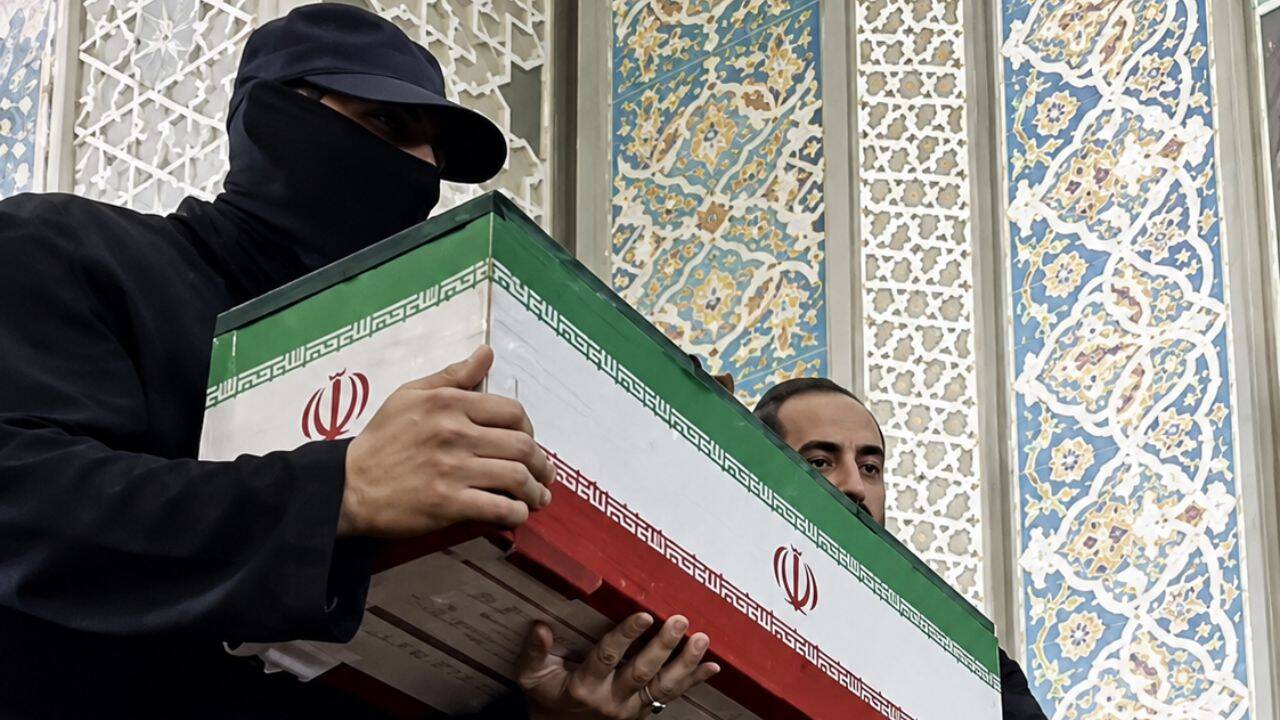
When a man wearing a black baseball cap and a heavy face mask stood in the front row of prayers at Ayatollah Ali Khamenei's funeral, social media exploded. Millions watching the state broadcast across Iran immediately jumped to the same conclusion. They thought they were looking at Mojtaba Khamenei, the newly appointed Supreme Leader, supposedly attending his father's final rites in disguise.
The reality turned out to be less about a secret agent disguise and more about the brutal aftermath of military conflict. The masked man was actually Mohammad Javad Khamenei, the late Ayatollah's eldest grandson. He wore the mask to cover severe facial injuries and burns suffered during the February 28 joint US-Israeli airstrikes—the very same strikes that killed his 86-year-old grandfather.
While Iranian media outlets like the Rokna news agency and Iran International quickly solved the immediate mystery of the man's identity, the wild speculation highlights a much deeper problem for Tehran. The frantic rumor mill shows just how anxious the public is about Iran's invisible leadership.
The Mystery Grandson and the Ghost Leader
Mohammad Javad Khamenei, the son of Ali Khamenei's eldest son Mostafa, was prominently positioned next to the coffin during the private ceremony at the Imam Reza shrine in Mashhad. Because he was helping lead the prayers reserved for the inner circle, his obscured face naturally drew intense scrutiny.
But the reason everyone assumed he was Mojtaba is simple. Nobody has actually seen Mojtaba in public for over four months.
Mojtaba Khamenei reportedly took the reins as the third Supreme Leader in March, shortly after the February airstrikes wiped out several members of the ruling family. Since then, his public profile has been non-existent. He hasn't given a single televised speech. He hasn't released a single audio recording. The lack of visibility has triggered intense skepticism within the country, earning him the mocking internet nickname of the "cardboard Ayatollah."
What the Disfigurement Rumors Mean for Tehran
Western intelligence reports suggest that the new Supreme Leader's absolute seclusion isn't just a standard security protocol. Evidence points to Mojtaba being severely injured and disfigured in the exact same February 28 attack that wounded his nephew Mohammad Javad.
This creates a massive optical crisis for a theocracy that relies heavily on the physical aura of its spiritual leaders.
- The Power of Presence: In Shia traditional governance, the Supreme Leader is expected to lead prayers, address the faithful directly, and project absolute strength. A leader who only exists via Telegram text messages inherently struggles to command authority.
- The Martyrdom Strategy: The regime purposely buried the late Ayatollah at the Imam Reza shrine in Mashhad—Shia Islam's holiest site in Iran—to lean heavily into the narrative of "tragic martyrdom" and spark national unity.
- The Legitimacy Gap: While the state claimed up to 43 million people turned out for the multi-day funeral processions across Iran and Iraq, the visible absence of the actual successor undercuts the message of continuity.
The Islamic Revolutionary Guard Corps tried to calm the waters by publishing a new photo of Mojtaba wearing a turban and glasses, claiming he remains in excellent health. But the public didn't buy it. The image looked heavily staged, with no verifiable timestamp or location, doing little to squash the rumors that the regime's top man is incapacitated.
Next Steps for Following the Iran Power Shift
The identity of the masked man is settled, but the stability of Iran's top office remains highly volatile. If you are tracking geopolitical risks or energy markets tied to Middle Eastern stability, stop focusing on the funeral rumors and monitor these concrete indicators instead:
- Watch the Friday Sermons: Keep tabs on who Tehran selects to deliver the high-profile Friday sermons in the coming weeks. If Mojtaba continues to delegate these to legacy clerics, his physical incapacity is virtually guaranteed.
- Monitor the IRGC Media Machine: Look for transitions from static text statements to actual audio or video broadcasts on official state channels. A genuine video address is the only way the regime can truly debunk the disfigurement narrative.
- Track Internal Dissent Metrics: Watch for growing factional splits within the Iranian parliament. A hidden leader naturally invites secondary power players to start carving out their own domains, signaling a fractured regime from within.