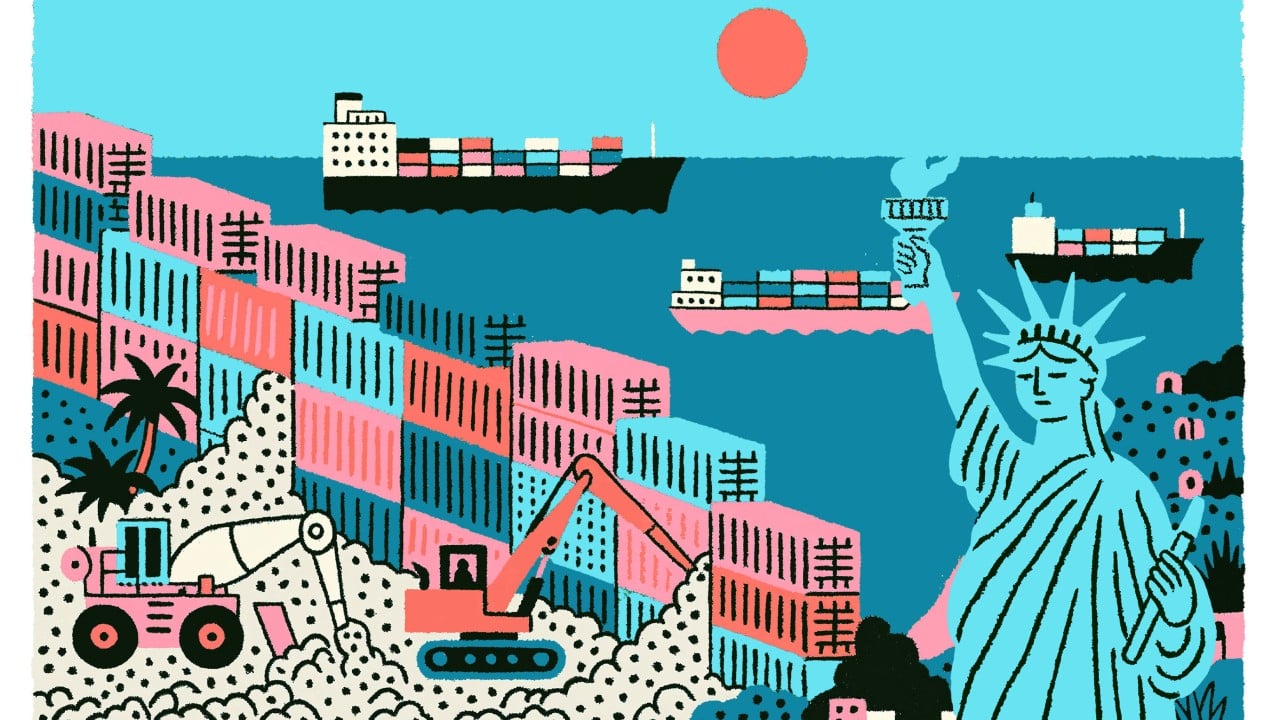
When President Donald Trump stood in the White House Rose Garden and declared "Liberation Day," the promise was straightforward. By slapping massive, reciprocal tariffs on foreign goods, America would allegedly fix its trade deficit, force factories to move back home, and make the domestic economy rich again. It was a bold economic vision based on a simple premise: if you build a wall of taxes, the world will have no choice but to build its factories inside your borders.
Except that isn't what happened.
One year after those sweeping import duties rolled out, the data paints a completely different picture. The US didn't box in its trading partners. Instead, Washington managed to box itself into a corner. Understanding where this policy went wrong requires looking past the political theater and examining the cold reality of global supply chains.
The Mirage of the Shrinking Trade Deficit
The core objective behind the policy was explicit. The administration labeled persistent goods trade deficits a national emergency. Hicking up tariffs to their highest levels since the 1930s was supposed to balance the scales.
But trade deficits aren't driven by how much you tax foreign goods; they're driven by macroeconomic realities like national savings and investment rates. According to data from the Bureau of Economic Analysis, the US goods deficit actually climbed to an all-time high in 2025. The pre-tariff trade deficit sat at $903.5 billion in 2024 and barely budged in 2025, dropping by a meaningless 0.2% globally while increasing in specific sectors.
Yes, the bilateral trade deficit with China fell by 32% as direct imports dropped. But the money didn't stay in America. It just leaked elsewhere.
Importers quickly shifted their supply chains to countries like Vietnam, Mexico, and India. Vietnam and Mexico saw massive jumps in their share of US imports, particularly in high-demand sectors like AI computing infrastructure and electronics. China, meanwhile, didn't experience the economic collapse some predicted. Beijing diversified its own trade, increasing its exports to Africa by 25.8% and to the ASEAN bloc by 13.4%, ending 2025 with a record $1.2 trillion global trade surplus.
Why Manufacturing and Farming Paid the Price
The policy assumed that companies would respond to tariffs by immediately hiring American workers. The reality is that modern manufacturing relies heavily on imported parts. Over half of all US imports consist of industrial supplies and capital goods. When you tax those components, you make domestic manufacturing more expensive, not less.
The results speak for themselves:
- Job Losses: The US manufacturing sector shed roughly 100,000 jobs between January 2025 and April 2026.
- Industrial Contraction: The ISM Manufacturing Index showed that American manufacturing contracted for nine consecutive months after the Liberation Day announcement.
- Historic Lows: The ratio of manufacturing workers to total nonfarm employment dropped to its lowest point since the Bureau of Labor Statistics began tracking the metric in 1939.
American agriculture took an even harder hit. Farmers were crushed by a double-whammy of retaliatory foreign tariffs and soaring prices for essential equipment. The cost of imported farm machinery and agricultural chemicals spiked by $958 million in just a few months. Consequently, the US agricultural trade deficit widened from $37 billion in 2024 to $41 billion in 2025, leaving major farming organizations warning that a significant number of operations are now financially underwater.
The Legal and Economic Aftermath
The administration tried to fund this shift by using the International Emergency Economic Powers Act (IEEPA) to bypass Congress. That strategy fell apart in February 2026 when the courts ruled the emergency IEEPA tariffs illegal.
This legal defeat created a massive administrative mess. The Tax Foundation noted that customs duties brought in $264 billion in 2025, up from $79 billion the year before. But because of the court ruling, the federal government has to refund roughly $166 billion in collected tariff payments. Whatever extra revenue the Treasury temporarily held is being wiped clean, leaving businesses to sort through the regulatory chaos.
Furthermore, these taxes didn't come out of the pockets of foreign corporations. Multiple economic studies, including research from the National Bureau of Economic Research on previous tariff rounds, confirm that import duties pass through directly to domestic buyers. US businesses and consumers paid the tax, which Federal Reserve Chair Jerome Powell noted added stubborn upward pressure on remaining inflation.
Your Next Strategic Moves
If you manage a business navigating this volatile trade environment, relying on a return to old-school globalization isn't a viable strategy. Protectionism has become a bipartisan fixture in Washington, even if the specific tactics change. You need to adapt your operations to handle permanent trade friction.
Map Your Sub-Tier Supply Chain
Don't just look at your direct suppliers. You need to know exactly where your suppliers get their raw materials. If your Mexican partner relies heavily on Chinese steel or electronic components subject to secondary tariffs, your supply chain remains exposed. Use supply chain mapping software to audit your risk down to the tier-three level.
Shift to "Near-Shoring" and "Friend-Shoring"
Moving production entirely to the US is often cost-prohibitive, but you can buffer against trade wars by shifting assembly to regional trading blocs. Focus on countries covered by robust trade agreements, like Mexico and Canada under USMCA, or emerging hubs in Central America.
Build Tariff Adjustments into Your Contracts
Stop signing long-term supply contracts with fixed pricing that leaves you holding the bag when duties change. Insert "Material Adverse Change" or explicit tariff clauses into your procurement agreements. These clauses should allow for automatic price renegotiations or cost-sharing if import duties swing by more than a specified percentage.