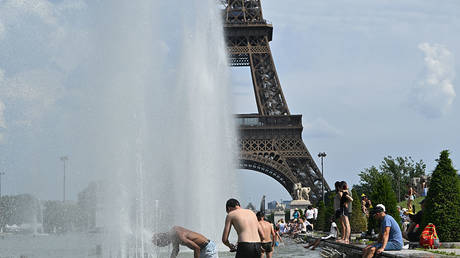
The ground in western Europe is basically baking right now. If you've been reading the headlines, you know a terrifying heatwave is sweeping the continent. But the mainstream media coverage is missing the real story. They show you photos of tourists splashing in Rome's Trevi Fountain or teenagers jumping into the Seine in Paris.
It looks like a collective summer vacation. It isn't. It's a mass casualty event.
Right now, a monstrous weather pattern has trapped an unprecedented heat dome over the continent. The numbers coming out of Spain, France, Italy, and the UK aren't just high; they're fundamentally breaking the systems we rely on to stay alive. Spain's Carlos III Health Institute, through its MoMo mortality monitoring system, tracked a staggering jump in fatalities, estimating over 212 heat-related deaths in just a four-day window from Sunday to Wednesday.
This isn't a normal summer. It's a glimpse into a brutal new reality.
The Omega Block Trapping the Continent
To understand why this specific heatwave is killing people, you have to look at the sky. Meteorologists are pointing at a phenomenon called an Omega block.
Picture a massive high-pressure system sandwiched between two low-pressure systems. It forms the shape of the Greek letter $\Omega$. This high-pressure system acts like a giant concrete lid on a pot, trapping hot air underneath and compressing it. As the air compresses, it heats up even more.
Because of the blocking action of the flanking low-pressure zones, this system doesn't move. It just sits there, cooking the land day after day.
The raw numbers from the national weather agencies are genuinely hard to process:
- France: Météo-France recorded the country's hottest day since records began nearly 80 years ago, with the southwestern town of Pissos hitting a mind-boggling 44.3°C (111.7°F). Paris shattered its own June record at 40.9°C.
- United Kingdom: The Met Office logged a record-breaking June temperature of 36.1°C (96.98°F) in Gosport, Hampshire, triggering only the second extreme heat warning in British history.
- Spain: Temperatures routinely cleared 40°C even in northern regions like Cantabria and the Basque Country, areas historically insulated from extreme southern heat.
The Unseen Casualties and the Drowning Crisis
When people think of heatwave deaths, they think of heatstroke. They think of elderly people collapsing indoors. That's a massive part of it, but this heatwave has revealed a completely different, tragic trend that caught authorities completely off guard.
People are drowning trying to escape the heat.
In France alone, at least 48 people drowned in less than a week. The heat became so unbearable that thousands swam in unsupervised rivers, lakes, and dangerous stretches of the Atlantic seaboard. When your body is overheated and you plunge into cold natural water, your system undergoes severe cold shock, leading to instant hyperventilation and cardiac stress. It’s a silent killer.
Add to that the infrastructure failures. In Brittany, a vital transformer station failed due to heat stress, knocking out power to tens of thousands of homes. Think about that: families trapped in un-air-conditioned apartments, with no power even to run a simple electric fan, while the air outside feels like an oven.
The agricultural sector is also taking a beating. In western France, hundreds of thousands of birds died at poultry farms within 48 hours because modern ventilation systems couldn't keep up with the ambient outdoor temperature. Farmers in several regions have completely shifted their schedules, running harvests exclusively at night to save their workers from collapse and prevent sparks from igniting catastrophic crop fires.
Why Europe's Infrastructure is Failing the Test
The underlying problem is that western Europe was built for a climate that no longer exists.
Unlike the southern United States or parts of the Middle East, where air conditioning is a standard baseline infrastructure, central and northern Europe relies on passive cooling. Buildings are designed to retain heat. Thick brick walls, insulation, and large windows are meant to keep people warm during long, damp winters.
When a heat dome settles over London or Paris, these buildings turn into literal green houses. They absorb heat all day and refuse to let it go at night. In Paris, nighttime temperatures stayed above 20°C (68°F), preventing human bodies from recovering and cooling down during sleep.
The transportation grid is buckling under the pressure too. In the UK, rail operators had to introduce strict speed restrictions and cancel dozens of commuter services. Why? Because steel rails absorb the direct sun and can heat up to 20°C hotter than the air temperature, causing the tracks to physically buckle and warp.
How to Handle Extreme Heatwaves Successfully
If you are currently facing these temperatures, you need to abandon the standard advice of just "drinking water." When temperatures exceed 35°C, your body relies almost entirely on sweating to cool down. If you don't manage your environment and electrolytes, you risk severe heat exhaustion.
Manage Your Living Space Effectively
Don't keep your windows open all day thinking you're getting a breeze. If the air outside is 38°C, you're just inviting a furnace into your living room. Shut all windows and draw heavy blinds or curtains the moment the sun hits your side of the building. Only open them late at night when the outdoor temperature drops below your indoor temperature.
Prioritize Electrolytes over Plain Water
Drinking gallons of pure water while sweating heavily dilutes the sodium levels in your blood, a dangerous condition called hyponatremia. Mix in sports drinks, rehydration salts, or eat light, salty snacks alongside your water intake.
Know the Red Lines of Heat Illness
Heat exhaustion is manageable; heatstroke is a medical emergency. If you or someone around you stops sweating, becomes confused, starts slurring words, or vomits, their internal thermostat has broken down. Move them to a shaded area immediately, douse their clothing in cool water, and call emergency services. Do not try to give them a drink if they are disoriented.
The World Meteorological Organization has explicitly stated that Europe is warming at more than twice the global average. This Omega block won't be the last one. The old playbook of waiting out a hot week doesn't work anymore. You have to actively adapt your routine, your home, and your safety measures to survive the new summer reality.