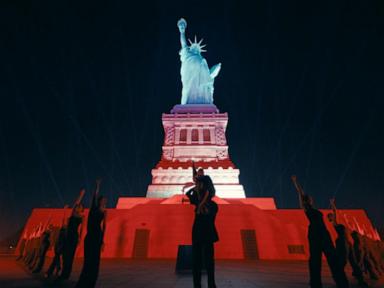
You’ve heard the boilerplate speeches about the United States turning 250. You know the ones. They talk about the world’s oldest democracy shaking hands with the world’s largest democracy, throw in a couple of stock clips of global summits, and call it a day. But a diplomatic anniversary video dropped by the US Embassy in India hits a different nerve. It isn’t just a checklist of trade treaties or strategic military alignments. Instead, it relies on a powerhouse roster of India’s most influential cultural and corporate heavyweights to explain what the "Idea of America" actually looks like from the outside.
And honestly, it doesn’t look like what the politicians are selling.
When you assemble people like AR Rahman, Indra Nooyi, Sabyasachi Mukherjee, and Viswanathan Anand in a single cinematic tribute, you aren't just making a birthday video for Uncle Sam. You're analyzing a cultural export machine that has quietly rewired the global brain. The real connection between these two nations isn't found in a joint communiqué signed by Donald Trump and Narendra Modi at a G7 summit. It's found in the weird, hyper-competitive, and creative ecosystem that forces foreign outsiders to look at their own limits and decide they can push past them.
The Myth of the Perfect Meritocracy
Let’s dismantle the most common narrative first. In the tribute, former PepsiCo CEO Indra Nooyi calls the US a "true meritocracy." It's a nice sentiment, but let’s be real. Anyone who has tried to scale the corporate ladder knows that pure meritocracies don't exist in a vacuum. What the US actually possesses is an brutal, unforgiving proving ground where the sheer scale of the market creates room for outliers.
Look at what podcaster Raj Shamani notes in the clip. He calls America the cradle of modern enterprise, a place "where empires start in garages, and the impossible becomes the everyday." That's the actual mechanics of the American dream. It isn't that the system is perfectly fair. It's that the infrastructure allows a good idea to scale aggressively fast before the status quo can shut it down.
When businesswoman Isha Ambani praises the American spirit of innovation, she isn't just talking about tech patents. She's talking about the cultural permission to fail. In many traditional societies, failing publicly is a death sentence for your career. In the American business landscape, a failed startup is just an expensive line item on your resume that proves you tried. That distinction changes how people dream.
Why Indian Creators Are Obsessed with the American Muse
The coolest part of this cinematic tribute isn't the corporate talk. It's the artists. Fashion visionary Sabyasachi Mukherjee and actress Rituparna Sengupta frame the American landscape as a literal catalyst for their own scale of ambition. Sabyasachi frankly admits that the nation’s influence helped him "dream big, really big."
Think about the irony there. Sabyasachi is a designer whose entire brand identity is rooted in hyper-traditional Indian heritage, textiles, and history. Yet, the emotional permission to scale that heritage into a global luxury empire came from observing American maximalism.
We see this same paradox in how AR Rahman and chess grandmaster Viswanathan Anand approach their crafts. They didn't grow up wanting to copy American culture. They used American icons as benchmarks for excellence. Anand looked at the raw competitive aggression of John McEnroe and Michael Jordan. Rahman looked at the genre-bending genius of Bob Dylan and Chick Corea.
They weren't consuming American culture to become American. They were using it as a mirror to figure out how to dominate their own fields on a global scale. Actor R Madhavan sums it up perfectly when he notes that the US has "compelled us to rise way beyond our conditioning."
Striving as a Universal Language
The video spends a good chunk of time focusing on sports icons like Mithali Raj, PV Sindhu, Vijay Amritraj, and Rahul Dravid. They talk about a narrative of "striving and refusing to quit."
Every country has athletes who train hard. But the US sports industrial complex turned individual striving into a global prime-time product. When an athlete in Chennai watches an NBA game or a tennis match at Arthur Ashe Stadium, they aren't just watching a game. They're watching the monetization of human willpower. That specific language of spectacle and relentless self-improvement is what India's sporting elite connected with. It's a template for how to turn raw talent into an institution.
The scientific community in the tribute points to this same relentless push. ISRO Group Captain Prasanth B Nair and Astronaut Shubhanshu Shukla look at America’s space legacy through the lens of pure curiosity. Retired NASA astronaut Sunita Williams frames it from the Wright brothers' first flight to the modern frontiers of space. The message here isn't that America owns these achievements. It's that America provided the sandbox where these cosmic experiments could happen without anyone asking "what's the immediate return on investment?"
The Geopolitical Reality Behind the Cinematic Fluff
Let’s pull back the curtain on why this video exists right now in 2026. US Secretary of State Marco Rubio, US Ambassador to India Sergio Gor, and Congress leader Shashi Tharoor want to anchor the geopolitical sentiment that the two countries are "united in the democratic spirit."
Sure, democracy is the shared vocabulary. But the real glue is the sheer volume of human capital moving between the two nations. As Indiaspora recently highlighted in their "250 @ 250" initiative, the Indian American story is no longer a fringe immigrant narrative. It's a foundational pillar of modern American tech, medicine, and corporate governance.
When the US Embassy curates a video like this, they aren't lecturing India on American greatness. They're acknowledging that the "Idea of America" is now partially manufactured, maintained, and redefined by Indians themselves. You can't separate modern American tech innovation from the Indian engineers running Silicon Valley, just like you can't separate the new wave of American culinary and artistic identity from the diaspora.
What to Do With This Information
If you're an entrepreneur, creator, or professional trying to build something that lasts, stop looking at America as just a geographic marketplace or a destination for a visa. Treat it as an operating system.
Here is how you actually leverage the insights from these icons:
Build for scale from day one. Don't design a product or a piece of art just for your local neighborhood. The American lesson is that your infrastructure should be ready to explode globally if the market demands it.
Adopt the garage mindset. Stop waiting for perfect funding or institutional approval. The empires celebrated by these icons started with zero resources and high conviction.
De-risk your relationship with failure. If you're running a business or a creative project, treat your mistakes as data points. The secret weapon of the American ecosystem isn't its wealth; it's the speed at which it forgets a flop and moves to the next launch.
Happy 250th, America. Thanks for the sandbox. Now it's time for the rest of the world to show you how to play in it.