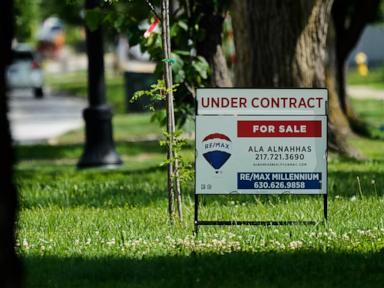
You think you're ready to buy a house, you balance your budget, and then the market shifts. That's the reality facing buyers this week as the average 30-year US mortgage rate ticked up to 6.49%.
According to fresh data from Freddie Mac, that's an increase from 6.43% just last week. While it might look like a tiny fractional bump on paper, these micro-moves completely alter your monthly payment. If you've been waiting out the market hoping for a return to the sub-6% rates we briefly teased earlier this year, honestly, it's time to adjust your strategy.
The dream of cheap borrowing is hitting a wall of global economic tension and stubborn inflation. Let's look at what's actually driving this spike and what you can do about it right now.
What is Pushing Mortgage Rates Back Up
You can blame the bond market and global geopolitics for this latest headache. Mortgage rates don't move in a vacuum. They generally mirror the 10-year Treasury yield, which jumped to 4.55% this week.
When bond yields rise, mortgage rates follow almost instantly. The main catalyst right now is the unstable situation overseas, specifically the conflict involving Iran. The geopolitical friction disrupted oil flows, driving crude prices higher and renewing fears that inflation will stay hot.
When inflation threatens to stick around, investors demand higher yields on long-term bonds. That means lenders have to price home loans higher to keep up. Just look at the timeline. In late February, before the major geopolitical escalations broke out, the 10-year Treasury yield sat at a comfortable 3.97%. The 30-year mortgage rate had even dipped below 6% for a fleeting moment. Since then, the breakdown of ceasefires and ongoing instability have kept a heavy upward pressure on everything.
Borrowers looking at shorter-term options aren't escaping the pain either. The 15-year fixed-rate mortgage, usually the go-to for people looking to refinance, crept up to 5.82% from 5.79% last week.
The Actual Cost of a 6.49 Percent Mortgage
Let's skip the abstract percentages and look at real-world math. If you are shopping for a $400,000 home and planning to put 10% down, you're looking at a loan balance of $360,000.
- At a 5.9% rate, your principal and interest payment sits around $2,135 a month.
- At today's 6.49% rate, that same $360,000 loan costs you roughly $2,273 a month.
That is an extra $138 every single month. Over the course of a 30-year loan, that tiny rate increase drains nearly $50,000 extra from your pocket. That's why buyers are hitting the brakes. The National Association of Realtors reported that existing home sales are essentially scraping along a 4-million annual pace, a massive drop from the historical norm of 5.2 million. People simply cannot afford the loss of purchasing power.
How to Navigate This Real Estate Market
Waiting for rates to drop back to 3% or 4% is a losing strategy. It isn't happening anytime soon. Instead of benching yourself, you have to play the game differently.
Negotiate a Rate Buydown
Don't just ask sellers for price cuts. Ask them for a temporary or permanent rate buydown. A 2-1 buydown allows the seller to credit money into an escrow account that lowers your effective interest rate by 2% in the first year and 1% in the second year. It gives you immediate breathing room while you wait for inflation to cool off over the next couple of years.
Shop Regional Banks and Credit Unions
Big national lenders have rigid pricing. Local credit unions and regional banks often hold loans on their own books rather than selling them to Wall Street. Because of this, they can sometimes offer rates that are a quarter to a half-point lower than the national average just to win your business.
Consider an Adjustable-Rate Mortgage with Caution
If you don't plan on staying in your starter home for more than five to seven years, a 5/1 or 7/1 Adjustable-Rate Mortgage (ARM) might make sense. These often feature lower initial rates than the standard 30-year fixed loan. You just need to ensure you have an exit plan—either selling or refinancing—before the fixed period ends and the rate adjusts.
Locking in a rate today is a hedge against further global volatility. If things worsen abroad, 6.49% might end up looking like a bargain by the end of the quarter. Track the 10-year Treasury yield daily, get your pre-approvals updated, and be ready to pull the trigger the moment you find a seller willing to negotiate on closing concessions.