When the twin 7.2 and 7.7 magnitude earthquakes tore through the north coast of Venezuela less than a minute apart on June 24, survival limits were immediately put to the test. Most disaster experts point to a strict seventy-two hour window for finding survivors under collapsed buildings. It's known as the golden period. After three days without water, the human body usually gives up.
Yet, eight days after the initial tremors, forty-three year old night security guard Hernán Alberto Gil Flores was carried out of the wreckage alive.
It wasn't just luck. It took a brutal, hundred hour international operation to extract him from beneath nine meters and one hundred and forty tonnes of shifting concrete at the Galerías Playa Grande shopping center in La Guaira. The logistics of this rescue show exactly what it takes to pull off a medical miracle when the physical environment is working entirely against you.
The Survival Physics of a Small Security Cabin
You don't survive over a week under a collapsed multi-story shopping mall by chance. Gil Flores survived because of geometry and placement. He was stationed inside a small basement security cabin when the floors pancaked above him.
While the surrounding nine-story concrete frame shattered, his reinforced metal workstation cabin held its ground. It took the brunt of the initial falling debris, creating a tiny, jagged pocket of air. This structural anomaly saved him from being crushed instantly, but it also trapped him in total darkness beneath a mountain of unstable rubble.
The biggest threat to life in these situations isn't just the lack of space. It's the air supply and temperature. In the scorching coastal heat of Venezuela, a sealed pocket can quickly turn into an oven, accelerating deadly dehydration. Gil Flores had no food and no access to a water source. He was burning through his body's reserves while breathing through a thick layer of concrete dust.
Sonar, Radar, and a Fear of Giving False Hope
By June 28, four days after the disaster, official hopes were wearing thin. The local forensic system was already entirely overwhelmed. Temporary morgues had been set up at the port city of La Guaira to handle a mounting death toll that quickly climbed past two thousand three hundred people.
That's when a specialized team from the Costa Rican Red Cross deployed acoustic sensors and advanced ground radar over the ruins of the shopping center. They picked up a faint, rhythmic signal deep in the basement.
When rescuers managed to drop an endoscope camera through a tiny fracture in the concrete slabs, they saw a subtle movement. A hand was waving through a gap. Gil Flores was alive, his head and shoulders visible, though one eye was severely bloodshot from a hemorrhage caused by the immense pressure and dust.
His first reaction wasn't a celebration. It was sheer survival pragmatism.
"When we found him, he asked us not to tell his wife that he was alive, just in case he wouldn't make it," recalled Minyar Collado, a Costa Rican Red Cross responder.
He didn't want to give his family false hope if the extraction failed. Outside, his wife, Gusbimar González, and their two children had spent days mourning what they assumed was his certain death.
Inside the Logistics of a Sand Castle Rescue
Finding a survivor is only ten percent of the battle. Extracting them without killing them, or the rescue team, is where the real nightmare begins.
A multinational coalition of over one hundred responders from Chile, the United States, Portugal, Mexico, Costa Rica, and El Salvador took over the site. The operation was coordinated by Chilean urban search and rescue teams alongside the United Nations Disaster Assessment and Coordination (UNDAC) team.
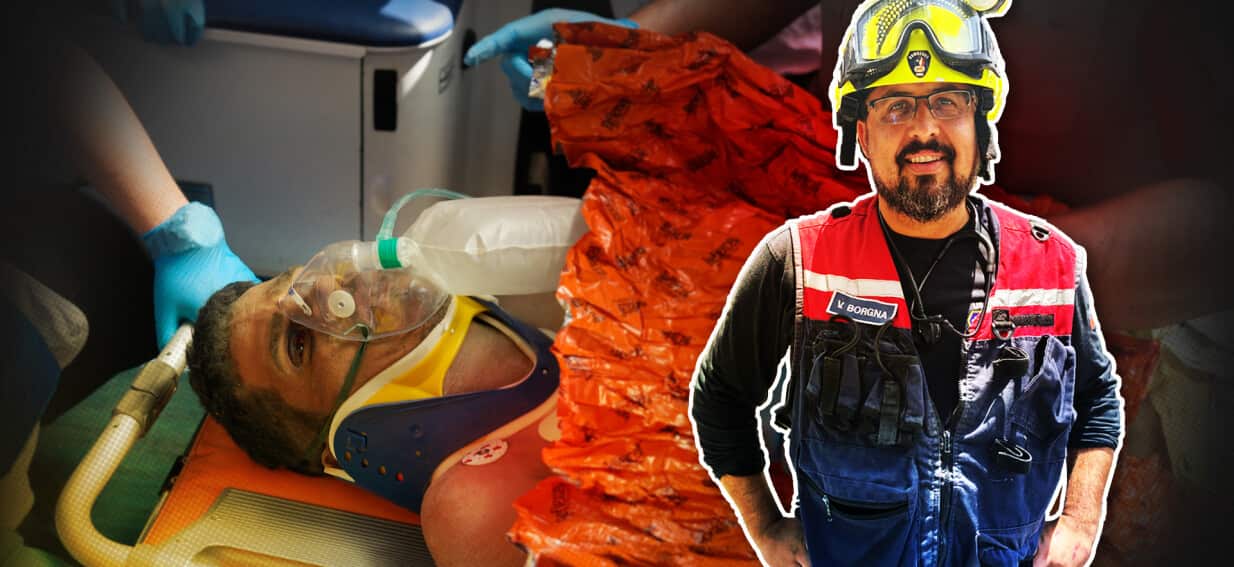
Vincenzo Borgna, the lead medic from the Chilean team, described the structural reality bluntly. He noted it was like a sand castle with a building on top. If you take one rock away, the whole thing falls.
+-------------------------------------------------------+
|  140+ Tonnes of Shattered Nine-Story Shopping Mall    |
+-------------------------------------------------------+
|   [!] Unstable Concrete Slabs & Metal Reinforcements   |
|       (Frequent Tunnels Collapses from Aftershocks)   |
+-------------------------------------------------------+
|   [~] 9-Meter Deep Manual Excavation Path              |
+-------------------------------------------------------+
|   [o] Tiny Air Pocket: Security Cabin Base            |
|       -> Victim: Hernán Alberto Gil Flores            |
+-------------------------------------------------------+
Rescuers had to dig a nine meter deep tunnel by hand, cutting through twisted structural steel and shattered masonry. Heavy machinery like excavators and cranes couldn't be used safely near the pocket because the vibrations threatened to trigger a secondary collapse of the adjacent structures. To make matters worse, some heavy equipment at neighboring sites had already ground to a halt due to severe local fuel shortages.
Continuous aftershocks and torrential rain repeatedly caused the hand-dug excavation tunnels to buckle and cave in. At one point, rescuers managed to get within fifty centimeters of Gil Flores before a structural shift forced them to pull back, abandon the tunnel, and re-evaluate their entire engineering plan.
Preventing Crush Syndrome through a Syringe
While firefighters dug, medics had to keep Gil Flores from dying of organ failure right under their eyes. When a person is trapped for days without fluids, their kidneys begin to shut down due to myoglobin buildup from muscle breakdown. This is compounded by severe dehydration.
Because they couldn't physically reach him yet, the Costa Rican and Chilean teams used thin, flexible hoses and long syringes threaded through the concrete cracks.
For nearly three days, this manual line was his only connection to life. Medics carefully administered precise amounts of water, intravenous fluids, and targeted electrolyte solutions. They couldn't just flood his system with liquid. Doing so too rapidly after prolonged dehydration can cause fatal cardiac arrhythmias or severe brain swelling.
To keep him from slipping into shock or panic during the grueling seventy-hour extraction process, a veteran Chilean rescue worker stayed on the audio feed constantly, talking him through the night. Remarkably, video captured by the rescue teams showed Gil Flores passing the hours by drawing pictures in the dust and debris to keep his mind sharp.
The Breakthrough and Next Steps
The breakthrough came late on July 2. Rescuers finally cleared the last barrier of twisted metal.
Despite spending one hundred and ninety-two hours under the rubble of a seven-story building collapse, Gil Flores defied medical expectations. He refused to be treated as a passive victim. When the tunnel was finally secure, he stood up on his own feet inside the crawlspace and climbed onto the rescue stretcher himself.
He was immediately rushed by a Red Cross ambulance to a localized medical facility for intense evaluation. While he escaped without major crushing fractures or life-threatening physical trauma, the long-term recovery path for an disaster survivor involves significant monitoring for acute kidney injury, respiratory issues from concrete dust inhalation, and severe post-traumatic stress.
If you want to understand how international disaster logistics operate during major seismic events, or how urban search and rescue teams deploy specialized radar in collapsed environments, look into the operational guidelines of the International Search and Rescue Advisory Group (INSARAG). They provide the global standards that allowed six different nations to seamlessly integrate their communication and engineering tactics on the ground in La Guaira.