You think automation is coming for your paycheck. In South Korea, it's already coming for your grief, your family dinner conversations, and your dating profile.
Western tech discussions usually spiral into arguments about software replacing corporate copywriters or code-monkeys. Step into Seoul, and you quickly realize that framework is way too narrow. The real shift isn't just about labor optimization. It is about a society restructuring its emotional, cultural, and domestic foundational pillars around artificial intelligence.
South Koreans are not just using algorithms to work faster. They are using them to find spouses, mourn the dead, and keep from dying alone in empty apartments. It's an intense, real-time social experiment. It shows exactly what happens when technology steps into the voids left by intense societal pressure and shifting demographics.
The Business of Digital Resurrection
Mourning used to be a static process. You looked at old photos. You played old voicemails. Today, South Korean tech startups are turning grief into an interactive digital asset.
Take a look at a Seoul-based startup called Vaice. They do not build generic chatbots. They take a handful of photos and a few brief voice recordings of a deceased parent or grandparent and turn them into a lifelike video avatar. For roughly 600,000 won—which is about 390 US dollars—families can buy a three-to-five-minute video message.
The customers themselves write the scripts. Then, the AI avatar delivers the words, speaking directly to the living during family gatherings or traditional memorial ceremonies.
Consider Lee Geon Hui, a young Korean who used the service to generate a video of his grandfather. The grandfather had died before Lee was even born. Lee gifted the video to his father. In the digital playback, the AI-generated grandfather apologized for past life regrets and told his living son how proud he was of him. It brought the family to tears.
It feels comforting on the surface. But look closer, and the ethical lines get messy fast. Yong Man Ro, a researcher at the Korea Advanced Institute of Science and Technology, points out that this tech acts as a double-edged sword because it actively manipulates raw human emotion. When you write the script for a dead person to say exactly what you always wanted to hear, are you actually healing? Or are you just designing a closed feedback loop to escape the painful reality of closure?
Memory Chips as the Ultimate Wedding Asset
If AI can recreate the dead, it can definitely rewrite your status among the living. The global explosion of generative tech has completely upended South Korea's famously brutal marriage market.
Historically, if you wanted to be considered an elite marriage prospect in Seoul, you needed to be a doctor, a judge, or a prosecutor. That old hierarchy is breaking down. Today, engineers at Samsung Electronics and SK Hynix—the companies manufacturing the high-bandwidth memory chips that power global AI systems—are treated like absolute royalty.
Matchmaking agencies are adjusting their tier lists in real time. Son Dong-gyu, the head of the matchmaking firm Bien Aller, noted that chip engineers used to be ranked as solid B+ or A- candidates. Now, they are pushed straight to A+ status. Massive corporate bonuses, rock-solid job stability, and skyrocketing global tech reliance have turned semiconductor workers into the most desirable partners in the country.
This status shift travels backwards into the education system. Universities are seeing unprecedented scrambles for semiconductor engineering tracks. Vocational high schools that pipe young graduates straight into chip foundries are overflowing with applicants. Koo Bon-ho, a semiconductor student at Korea University, admitted that the main draw is simple survival. In an era of terrifying youth unemployment, holding the keys to the physical infrastructure of AI means safety.
It means a guaranteed spot in a society that leaves little room for error.
Fighting the Silent Death Epidemic with Silicon
South Korea faces a terrifying demographic cliff. It has a rapidly aging population, a plummeting birth rate, and a massive spike in older adults living entirely alone. Isolation is a literal killer here. It feeds high rates of depression, poverty, and godoksa—the local term for lonely deaths where people pass away unnoticed.
Human social workers cannot keep up. The state is stepping in with machines.
Local municipalities have deployed thousands of AI-enabled companion dolls to vulnerable seniors. One major player is Hyodol, a stuffed doll built to look like a seven-year-old grandchild. It sits on a senior’s couch and talks. It reminds them to take their medication, tells them to drink warm water, warns them about phone scams, and chatters away using natural language models.
The raw data shows these dolls work. Studies tracking thousands of Hyodol users recorded a noticeable drop in depression scores and a major jump in medication compliance.
The human stories are even more telling. Look at 72-year-old Ahn So-hyun, who has lived alone for over two decades and struggles with severe visual impairment. She spends entire days without speaking to a single human soul. Her companion doll changed that. She openly states that the robot feels like real family.
Another senior, Kim Choong-ki, lived a chaotic, isolated life after his business went under years ago. The robot’s constant nagging to eat, stretch, and walk forced him back into a daily routine. When his doll broke down and went away for a month for repairs, the silence in his apartment was suffocating. He just sat there waiting for the machine to come back home.
On the software side, services like Naver Cloud’s "Talking Buddy" use automated care calls to check on the elderly. It is a system that literally saves lives. 77-year-old Jung Yun-hee was home alone when she experienced blinding abdominal pain. The automated AI happened to call for a routine check, heard her distress, and immediately flagged a central system to dispatch an ambulance. She had emergency surgery for an acute hernia that day.
But let’s be brutally honest about what is happening here. Society is outsourcing basic human empathy to code. Care centers monitor the transcripts, but the primary daily relationship these seniors have is with a synthetic personality.
Mainstream Automation at the Corner Cafe
Walk out of a quiet residential building and into the commercial streets, and the automation hits you in the face. Robot-run businesses are no longer experimental gimmicks hidden in high-tech corporate lobbies. They are scaling fast into everyday consumer retail.
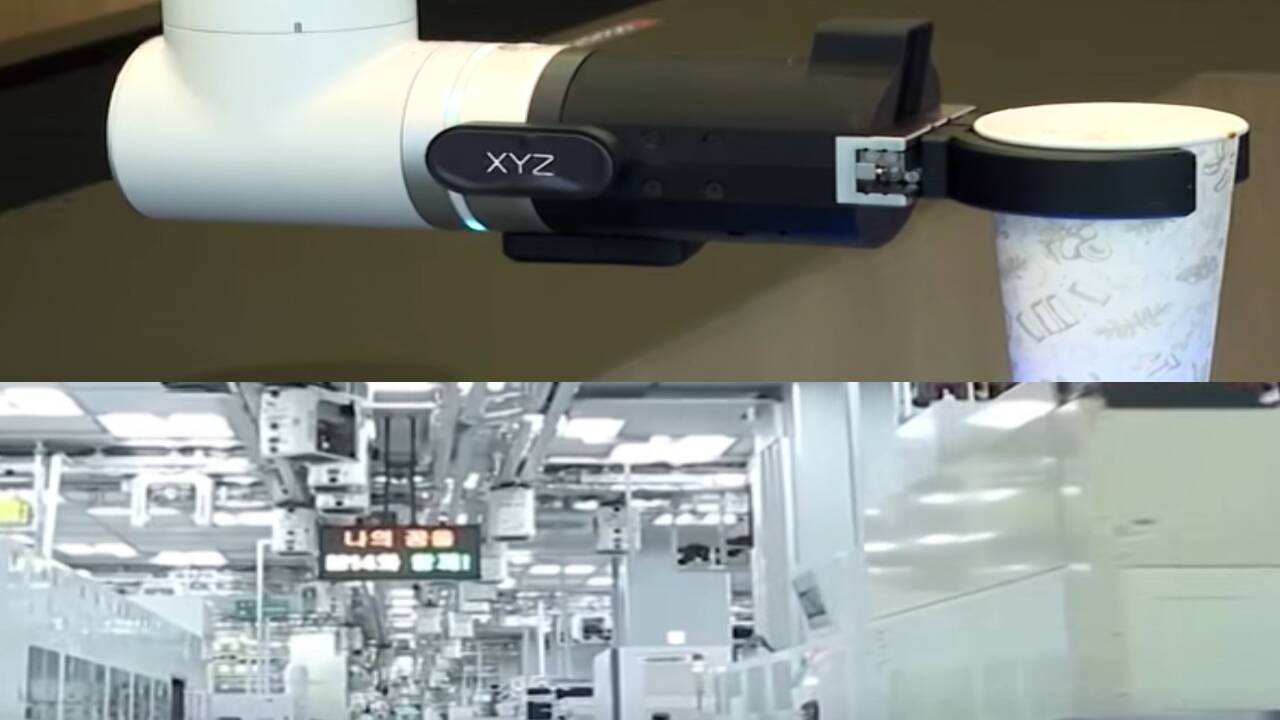
South Korea currently has hundreds of active robot cafes. Budget coffee giant Compose Coffee—which runs more than 2,000 human-staffed branches—just partnered with Rainbow Robotics to launch automated barista setups. Rainbow Robotics, now a subsidiary of Samsung Electronics, already operates its proprietary robot cafes at dozens of universities and highway rest areas.
They are deploying robotic arms with strict National Sanitation Foundation certifications to ensure flawless hygiene and identical beverage quality across the board. Franchise owners love it because it drops labor overhead and removes the headache of managing staff during early morning rushes.
Go to spots like Storant in Daejeon, and you will find a 24-hour, completely unmanned setup where an arm brews the coffee and an automated rolling cart brings the tray directly to your table. No small talk. No mood swings. No human friction.
But consumers are starting to notice the tradeoffs. Some local patrons point out that while the robot arm looks fascinating for the first two minutes, the experience quickly turns cold. You pay premium prices for a drink, but you lose the entire social texture of a neighborhood cafe. There is a reason morning crowds sometimes bypass an empty robot kiosk to line up at a small human-run shop ten meters down the road. Humans crave connection, even if it is just a brief nod from a busy barista.
The Trap of One Way Relationships
What happens when we get too comfortable interacting with things that cannot talk back with authentic agency? This is the core issue South Korean psychologists are shouting about.
Kwak Keum-joo, a psychology professor at Seoul National University, warns that relying on AI companions creates a massive communication hazard. Real human relationships are messy. They require exhausting compromises, active listening, emotional vulnerability, and mutual sacrifice. You have to deal with disagreements and bad moods.
An AI companion demands none of that. It listens 24/7. It tells you exactly what you want to hear, exactly when you want to hear it. It never gets tired, never argues, and never leaves unless its battery dies.
This uni-directional relationship model can ruin a person's ability to navigate the real world. If you spend all your time talking to an AI doll or an algorithmic avatar that adapts completely to your whims, real people will start to feel incredibly inconvenient. You stop trying to build real human networks because the artificial alternative is completely frictionless.
Real Steps for Navigating the Algorithmic Shift
You cannot stop this tech wave from spreading. If you want to understand how to live alongside these systems without losing your human edge, you need a strategy.
- Audit your tech dependencies. Look at where you use automated interfaces. Are you using an app or an AI assistant because it is genuinely efficient, or are you using it to avoid a minor, uncomfortable human interaction? Choose the human interaction at least half the time.
- Insist on physical community. Tech can handle administrative check-ins, but it cannot share a physical space. Join local clubs, volunteer at neighborhood centers, or visit local, human-staffed businesses. Protect spaces where people gather in person.
- Establish hard ethical boundaries for grief. If you use digital tools to preserve memories of lost loved ones, treat them strictly as digital photo albums. Do not use interactive scripts to simulate ongoing conversations. Let the dead rest, and allow yourself to go through the actual, unedited process of moving forward.
- Value soft skills over technical output. As automated systems take over technical tasks, your value lies in things machines cannot replicate: deep empathy, situational nuance, spontaneous creativity, and shared human vulnerability. Focus on building those traits every single day.
South Korea's high-tech landscape is a mirror for the rest of the world. The systems being deployed right now show that technology will gladly fill every emotional and social void we abandon. If we do not actively protect our real-world human networks, we will wake up to find them permanently replaced by highly efficient, deeply comforting, completely hollow code.