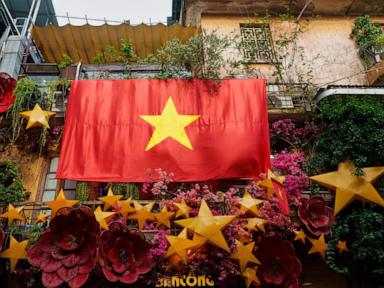
You can get arrested in Vietnam for complaining about a local official on Facebook. That is not an exaggeration. It is the current reality under a government that has systematically dismantled what little civil society it once had.
A new report from The 88 Project reveals that the Vietnamese government is aggressively accelerating its campaign to silence any voice it cannot control. In 2025 alone, the group documented 56 politically motivated arrests. That numbers represents a steady three-year climb. It is double the number of arrests recorded in 2022. Because authorities shroud these cases in secrecy, the actual number is likely much higher.
If you think this only matters to political activists inside the country, you are mistaken. Vietnam has positioned itself as the darling of Western trade agreements and a critical manufacturing alternative to China. Yet behind the shiny facade of economic growth lies a rapidly hardening police state. The international community is actively looking the other way while ordinary people are locked up for posting videos on YouTube.
The Rise of a True Police State Under To Lam
The tightening grip on Vietnamese society is directly tied to the political ascendancy of one man. To Lam spent years as the country’s top security official, heading the Ministry of Public Security. He became the general secretary of the Communist Party in 2024 and took over the presidency earlier this year. His background is not in economic planning or diplomacy. It is in policing, surveillance, and state security.
Under his leadership, the state has dropped any pretense of tolerating independent thought. Experts who track the region point out that the 2010s offered a brief period of relative openness. Back then, civil society groups could openly campaign on environmental issues, labor rights, and local policy. That era is completely dead.
The primary driver behind this current wave of paranoia is the fear of what the regime calls a color revolution. Vietnam's leadership looks at historical uprisings like the 1986 Yellow Revolution in the Philippines or the 2004 Orange Revolution in Ukraine with genuine terror. They see peaceful civic organization not as a sign of a healthy society, but as an existential threat to their monopoly on power.
This fear has created an ideological bridge to Beijing. Despite tense relations over competing maritime claims in the South China Sea, the two communist neighbors found common ground earlier this year. They formally agreed to prioritize political security and coordinate their efforts to resist these perceived revolutions. Vietnam is effectively adopting the Chinese blueprint for total societal control.
The Legal Weapons of Mass Suppression
The Vietnamese legal system does not exist to protect citizens. It exists to protect the party. Authorities rely heavily on two specific provisions in the penal code to criminalize everyday speech.
The first is Article 331. This law makes it a crime to abuse democratic freedoms to infringe upon the interests of the state. The maximum penalty is seven years in prison. The language is intentionally vague. What does it mean to abuse democratic freedoms? Whatever the local police department wants it to mean.
Initially, the state used Article 331 against high-profile dissidents and democracy advocates. Now, they use it against everyone. If a farmer complains about land corruption on social media, that is an infringement on state interests. If an indigenous person talks about religious freedom, they face the same charge.
The second weapon is Article 117. This section criminalizes making, storing, or disseminating information or materials aimed at opposing the state. It carries a terrifying penalty of up to 20 years in prison. It is the law used to crush journalists, lawyers, and anyone who attempts to analyze government policy objectively.
No One Is Safe Anymore
The 88 Project’s data shows a disturbing shift in who the government is targeting. They are no longer just going after seasoned political activists. They are hunting down ordinary citizens, legal petitioners, and even exiles.
Consider the case of the three men behind the YouTube channel Nguoi Da Tin, which translates to The Messenger. They used their platform to talk about local social issues. The government labeled their videos distorted content and arrested them under Article 331. They were not trying to overthrow the government. They were simply reporting on things happening in their communities.
Then there are the land rights petitioners. In Ha Tinh province, a man was arrested simply for helping his neighbors file formal complaints. The local government had expropriated their land for a development project, and the residents wanted fair compensation. In a functioning legal system, that is standard administrative procedure. In Vietnam, it is treated as a threat to national security.
The long arm of the state now extends beyond its borders. An activist from the minority Montagnard ethnic group fled Vietnam to seek safety in Thailand. Vietnamese agents tracked him down, and he was extradited back to Vietnam to face prosecution. The message from Hanoi is clear. Run all you want, we will still find you.
Even legal professionals are in the crosshairs. Human Rights Watch documented the case of Nguyen Van Dai, a prominent human rights lawyer. At the end of last year, a court in Hanoi sentenced him in absentia to 17 years in prison under Article 117. His crime was criticizing party leaders on social media. When the lawyers defending citizens are being sentenced to nearly two decades in prison, the entire justice system is a farce.
Social Media as a Trap
For a long time, platforms like Facebook and YouTube were seen as tools for liberation in authoritarian regimes. In Vietnam, they have become a highly effective trap.
Millions of Vietnamese citizens use social media every day. They use it to chat, run businesses, and express opinions. Because there are no independent newspapers or television stations in the country, the internet is the only place where real conversation can happen. The government knows this, and they have forced tech giants to cooperate with their censorship apparatus.
New draft policies and recent amendments to press laws have tightened the screws even further. Internet providers and tech platforms are now required to hand over user IP addresses to the police upon request. They must remove flagged content within 24 hours. If they do not comply, they risk being blocked entirely from a highly lucrative market.
This has left users incredibly vulnerable. Blogger Hoang Thi Hong Thai was arrested earlier this year by Hanoi police. She had spent over a decade writing about sociopolitical issues online. Before her arrest, she wrote about the immense personal cost of her work. Her family had been forced to move eight times. Her children had to switch schools four times. She kept writing because she believed in human rights. Now she is behind bars, and the platforms she used to share her message are complicit in the system that tracked her down.
The Price of Western Silence
Why is Vietnam able to carry out this brutal crackdown with zero international consequences? The answer comes down to economics and geopolitics.
Western democracies are desperate to de-risk their supply chains away from China. Vietnam has stepped into that vacuum perfectly. It has signed massive trade deals, including the EU-Vietnam Free Trade Agreement. It has welcomed billions of dollars in foreign investment from American, European, and Asian corporations.
This economic relevance has granted Hanoi a free pass on human rights abuses. Democratic leaders travel to Vietnam, sign trade pacts, shake hands with To Lam, and offer only meek, behind-closed-doors statements about civil liberties. Vietnam even secured a seat on the UN Human Rights Council while actively locking up people for typing words on a screen.
This hypocrisy undermines the global human rights framework. When Western governments prioritize cheap manufacturing over fundamental freedoms, they signal to authoritarian regimes everywhere that human rights are negotiable.
Real Steps for International Observers and Businesses
The current trajectory in Vietnam will not change on its own. The regime has verified that international lip service does not carry a financial or diplomatic penalty. If you want to see actual change, the strategy must shift.
- Enforce Trade Clauses: Free trade agreements like the one with the European Union contain explicit human rights clauses. These should not be symbolic. If Vietnam continues to double its political arrests, trade privileges must be suspended.
- Pressure Tech Giants: Companies like Meta and Google must face intense scrutiny over their compliance with Hanoi's surveillance demands. Shareholders and consumer groups need to demand transparency regarding how often these platforms hand over user data to the Vietnamese Ministry of Public Security.
- Support Local Documentarians: Groups like The 88 Project and Human Rights Watch rely on underground networks to verify these arrests. Funding and diplomatic protection for these tracking initiatives must be expanded so the state cannot hide its actions.
- Condition Diplomatic Engagement: Every bilateral meeting with Vietnamese officials must have the release of specific political prisoners as a non-negotiable agenda item. High-profile visits should be paused if arrests continue to escalate.
The situation in Vietnam proves that economic modernization does not automatically lead to political liberalization. Left unchecked, To Lam's administration will continue to refine its police state, turning Vietnam into a closed society where silence is the only safe option.