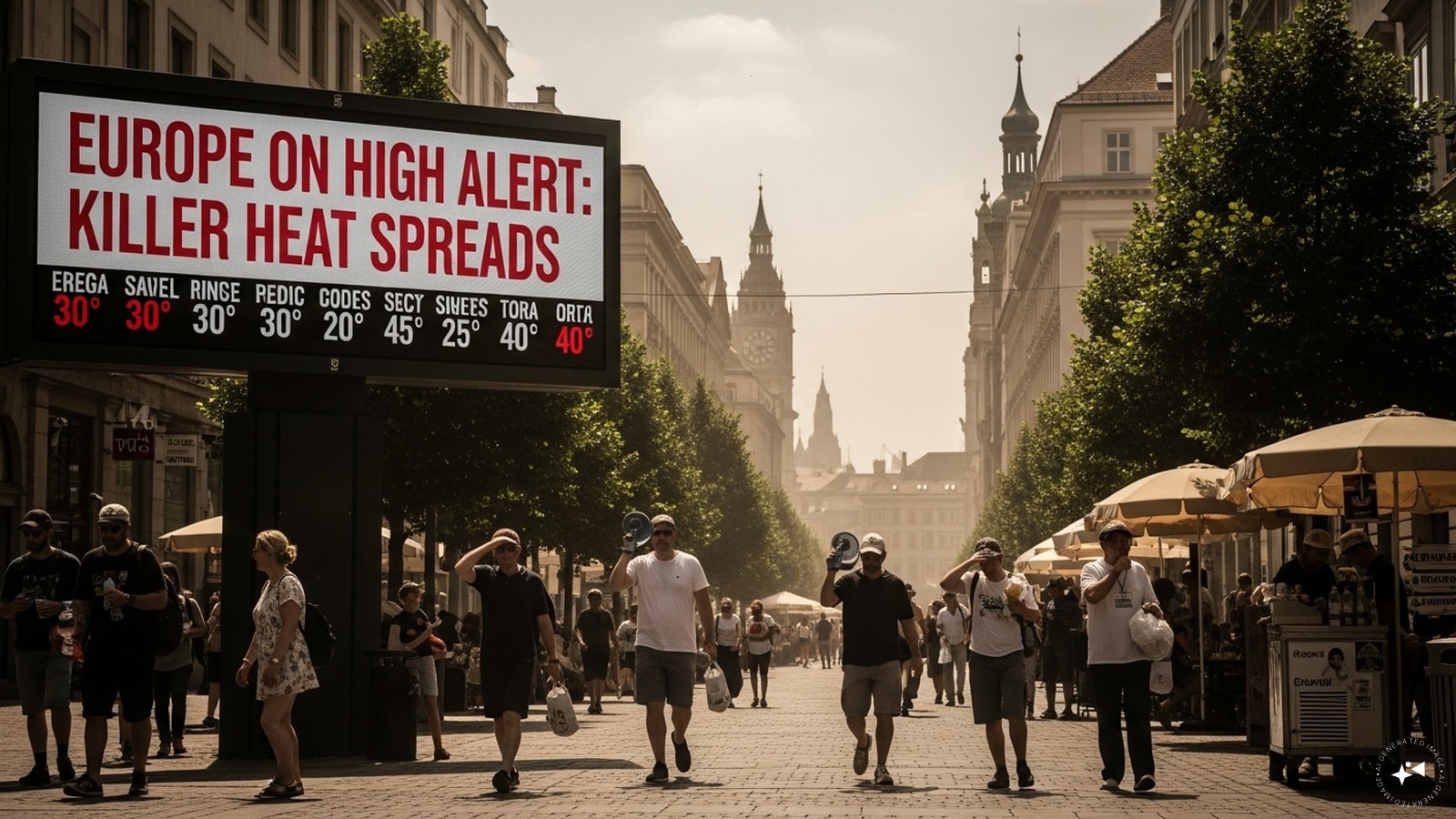
Europe is frying right now. If you think this is just another typical summer stretch, you are missing the bigger picture. The intense heatwave tearing across the continent this week isn't normal weather. A rapid analysis released today by the World Weather Attribution group confirms that fossil fuel emissions made this record-shattering June heatwave the most severe ever recorded in European history.
This is not a problem for tomorrow. It is happening right now, destroying temperature logs from London to Paris and forcing millions to endure life-threatening conditions.
Look at the numbers coming in from local weather stations. France just recorded its hottest day on record two days in a row, with the national average hitting a staggering 38.5 degrees Celsius on Wednesday. In the southwestern commune of Pissos, the mercury spiked to a blinding 44.3 degrees Celsius. The United Kingdom broke its June temperature record for three consecutive days, peaking at 36.7 degrees Celsius in Somerset on Thursday. These are numbers you expect to see in the middle of North African deserts, not in northern and western Europe before the official start of July.
People are looking for someone to blame, and scientists have pointed their fingers directly at human-induced global warming.
The Math Behind a Practically Impossible Heat Event
The World Weather Attribution study didn't mince words. The group compared our current reality to historical data and climate models to see how much human activity skewed the odds. The results are terrifying.
Fifty years ago, a heatwave of this magnitude in June would have been virtually impossible. Even back in 2003, during the historic heatwave that claimed over 70,000 lives across Europe, daytime heat like this would have been ten times less likely than it is today.
A massive, stubborn high-pressure system known as a heat dome is currently parked over Europe. This system acts like a giant lid on a boiling pot. It traps warm air at the surface, repels cloud cover, and lets the sun bake the earth relentlessly day after day. Because human activity has raised global temperatures by roughly 1.4 degrees Celsius above pre-industrial levels, the baseline temperature inside this heat dome is significantly higher than it ever would have been naturally.
We are seeing a faster rate of warming in Europe than anywhere else on earth. The continent is heating up faster because it sits right next to the Arctic. As northern snow and ice melt away, they expose dark land and water underneath. That dark surface absorbs the sun's rays instead of reflecting them back into space. This feedback loop accelerates local warming. The daytime temperature extremes across Western Europe are currently rising at three times the global average rate.
Why the Nights Are Becoming More Dangerous Than the Days
When people think of a heatwave, they picture blistering afternoons. The real danger of this specific 2026 event lies in what happens after the sun goes down.
Scientists are deeply alarmed by the lack of nighttime cooling. France just endured its warmest night in recorded history, with a national average overnight temperature of 21.6 degrees Celsius. Some regions didn't drop below 30 degrees Celsius all night. Meteorologists call these tropical nights. They are a silent killer.
Human bodies need nighttime relief to recover from daytime heat stress. When the air stays above 20 degrees Celsius and humidity climbs, your heart has to work overtime to pump blood to your skin to cool you down. You never actually rest. The World Weather Attribution team noted that the nighttime temperatures seen this week would have been more than 100 times less likely to occur back in 2003.
The humidity makes it significantly worse. High humidity stops sweat from evaporating off your skin, which is your body's main mechanism for dumping heat. The study found that 45 percent of cities analyzed across 30 European nations breached safe levels for the wet bulb globe temperature. This metric tracks how heat, humidity, wind, and solar radiation combine to stress the human body. Once that threshold is crossed, even healthy people can suffer heat stroke within hours of outdoor exposure.
Infrastructure Is Crumbling Under the Strain
Our cities were never built for this kind of climate. Much of Western Europe relies on historical architecture designed to retain heat during cold winters, not shed it during desert-like summers.
In Paris, the classic zinc rooftops that give the city its famous look are turning top-floor apartments into literal ovens. In Italy, the Uffizi Gallery had to halt ticket sales because its climate control systems simply couldn't handle the load. In Belgium, electricity prices spiked to a record of over one Euro per kilowatt-hour at sunset because the power grid was pushed to its absolute limit by air conditioning demand.
The water systems are feeling the heat too. French authorities noted that some rivers became so warm that they could no longer be used safely to cool nuclear power plants, threatening the energy supply right when demand peaked.
The human toll is mounting. Drowning accidents have spiked as desperate people jump into unsupervised waters to cool off, with 40 deaths reported in France alone. The London Ambulance Service reported its busiest day in history for life-threatening emergencies on Thursday.
Moving Past the Broken Record
Climate scientists are tired of repeating themselves. The solutions exist, but global implementation is lagging far behind the curve of temperature increases. This week is a preview of our collective future if fossil fuel reliance continues unchecked. Theodore Keeping, a researcher from Imperial College London who worked on the study, warned that we are moving toward a future where an average summer will be consistently hotter than this current extreme event.
You can take immediate, practical steps to protect yourself and your community as these events become more common.
First, audit your living space for heat resilience before the next wave hits. Install external window shutters or reflective films to block solar radiation before it hits the glass. Internal blinds help, but they still allow heat to enter the room.
Second, shift your schedule aggressively during alerts. Do heavy chores or exercise before 7 AM, or wait until well after dark.
Third, check on elderly neighbors daily. They often lose their thirst reflex and won't realize they are dangerously dehydrated until it is too late.
Stop viewing these events as freak weather anomalies. The data shows they are structural shifts in our climate system. Demand that your local representatives invest heavily in urban green spaces, cool roofs, and grid resilience. The climate isn't waiting for policy debates to catch up. Use this moment to adapt your home and habits immediately.