The ground in northern Venezuela didn't just shake once on June 24. It shook twice, back-to-back, with a terrifying violence that has now left at least 3,535 people dead. As rescue workers continue digging through rubble and international teams shift their operations, that number keeps climbing. Top lawmaker Jorge Rodríguez recently confirmed the grim milestone, alongside a staggering count of 16,740 injured and nearly 18,000 left completely homeless.
But these official figures tell only a fraction of the story.
When you look past the government press releases, a much more chaotic and desperate reality emerges. The disaster hit an area already struggling with deep economic issues, crumbling infrastructure, and severe resource shortages. The result is a humanitarian crisis that will take years, if not decades, to resolve. Understanding why this disaster is so uniquely destructive requires looking at the raw mechanics of the event and the structural vulnerabilities it exposed.
The Brutal Physics of a Doublet Earthquake
Most major earthquakes involve one massive shock followed by smaller aftershocks. That isn’t what happened here. Venezuela was struck by a rare seismic phenomenon known as a doublet.
The first quake registered a massive magnitude 7.2 near Montalbán, west of Caracas. Just 39 seconds later, before the ground could even stop moving or residents could flee their homes, a second, even larger magnitude 7.5 quake ripped through the exact same region.
This one-two punch is catastrophic for buildings. The first shake cracks concrete, weakens support beams, and compromises structural integrity. When the second, stronger wave hits less than a minute later, buildings that might have survived a single earthquake collapse instantly. This explains why search and rescue operations have been so slow and dangerous. Teams aren't dealing with simple debris. They're trying to navigate unstable, pancaked concrete structures that are shifting constantly.
The geographical distribution of the damage compounded the horror. The tremors heavily impacted Caracas, the densely populated capital, and blasted the coastal state of La Guaira. La Guaira sits squeezed between steep mountains and the Caribbean Sea. It has a long history of geological vulnerability, and this event has triggered massive landslides that cut off entire neighborhoods from emergency services.
The Massive Gap in the Data
If you want to understand the true scale of the disaster, look at the glaring disagreement between official state figures and independent satellite analysis.
The Venezuelan government currently lists 856 affected buildings, claiming that only 190 completely collapsed. On the surface, that sounds bad but manageable. However, preliminary satellite assessments from NASA and researchers at Oregon State University paint a completely different picture. Their orbital data indicates that closer to 58,870 buildings have been damaged or destroyed across the affected zone.
Why such a massive discrepancy?
Part of it comes down to access. Government officials are focusing primarily on easily accessible urban centers and highly visible public infrastructure. They lack the resources or perhaps the political will to log every cracked home in the hillside barrios surrounding Caracas or the isolated coastal pockets of La Guaira. In these informal settlements, houses are built vertically out of unreinforced brick and concrete block, stacked precariously on steep slopes. Thousands of these homes didn't just crack; they slid down hillsides or crumbled into dust. They aren't captured in the early state counts, but they represent thousands of families who have lost everything.
Mismanagement and Fuel Shortages on the Ground
Anger is boiling over in the streets of La Guaira and Caracas. Residents complain that emergency crews haven't even reached some collapsed homes more than a week after the disaster. The delay isn't necessarily due to a lack of bravery from local first responders. It's a logistical nightmare driven by the country's ongoing economic paralysis.
The most critical bottleneck right now is a severe fuel shortage. Heavy machinery like excavators, cranes, and bulldozers are sitting idle in disaster zones because there simply isn't enough diesel to run them. Rescue workers are literally forced to clear heavy concrete slabs by hand or with basic tools while family members wait outside, listening for signs of life beneath the ruins.
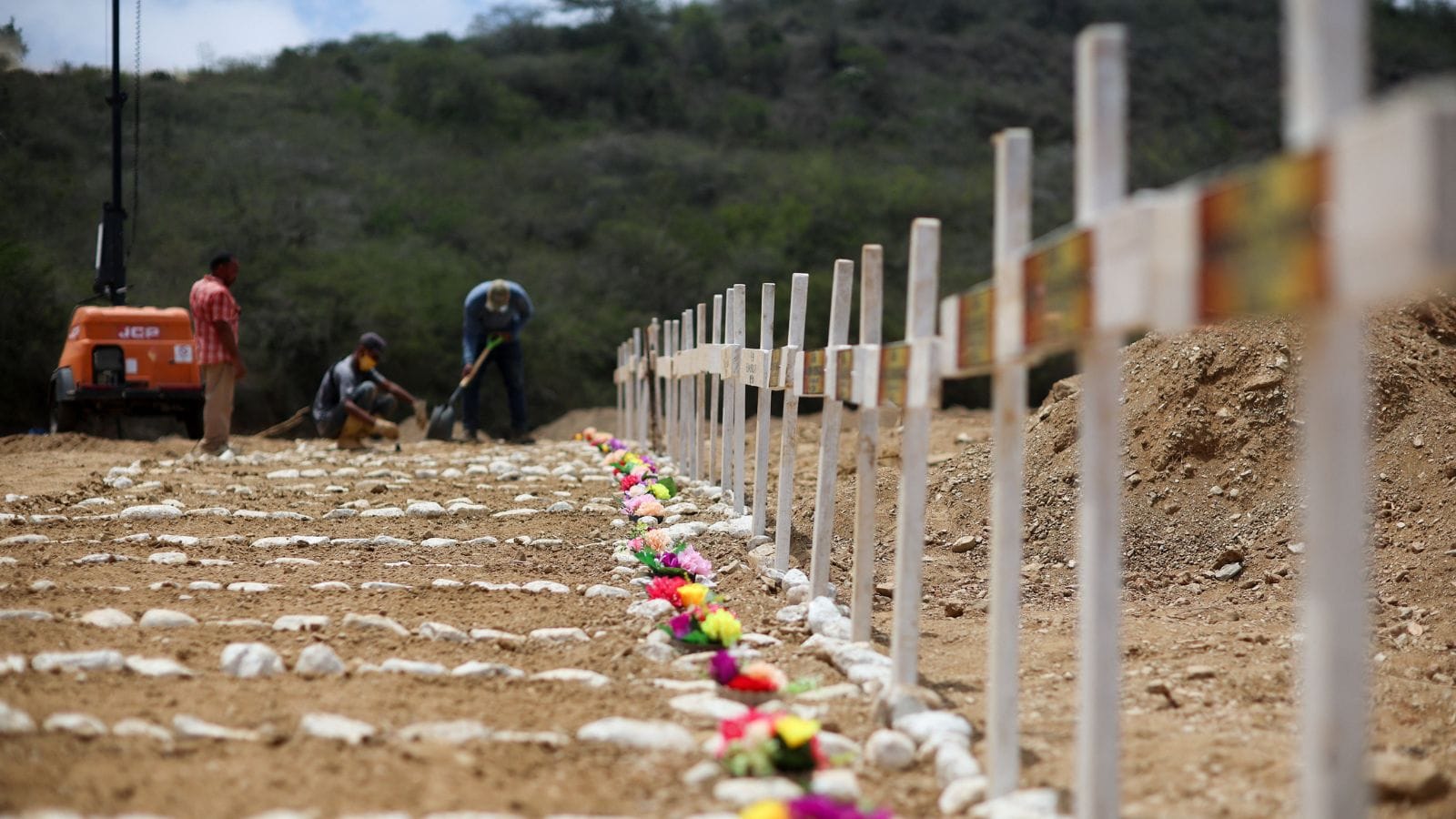
In La Guaira, the scene has turned deeply somber. Open areas are being converted into makeshift cemeteries. Trucks transport plain wooden coffins to fields marked by simple white crosses. Heavy machinery digs long trenches to bury unidentified bodies before the tropical heat creates a secondary public health crisis. Photos from the scene show some graves marked with names scribbled hastily on wood, while others bear only numbers.
Acting President Delcy Rodríguez has defended the state's response, pointing to the deployment of security forces and proposing a new military unit dedicated to future disasters. But for families sleeping on pieces of cardboard in the streets, bureaucratic promises don't replace missing loved ones or lost homes. The social vice presidency notes that around 12,800 people are crammed into 80 temporary shelters across Caracas and La Guaira. These shelters are already pushed past their limits, facing critical shortages of clean water, medicine, and basic sanitation supplies.
Economic Fallout and the Infrastructure Crisis
The financial impact of the Venezuela quakes is mind-boggling for an economy that was already fragile. The UN Development Programme estimates direct physical damage at roughly $6.7 billion, which translates to about 6% of the country's entire gross domestic product. Private risk modelers, including Verisk, put the total economic losses even higher, exceeding $10 billion.
The energy sector, which serves as the country’s economic lifeblood, didn't escape unscathed. State oil company PDVSA has been inspecting its Catia La Mar fuel terminal, located right in the heart of one of the worst-hit zones. While officials claim that oil exports have faced only minor disruptions, the structural integrity of the terminal's storage facilities and pipelines remains a major concern. Any prolonged shutdown here would choke off the domestic fuel supply even further, crippling both the rescue efforts and the broader economy.
Transportation is another massive hurdle. The twin quakes severely damaged Simón Bolívar International Airport in Maiquetía, the country's primary gateway to the world. Terminal buildings suffered major structural cracking, and air traffic control systems were knocked offline. Delcy Rodríguez announced a plan to get commercial flights running again using a parallel runway, but an operational restart takes time. Without a fully functioning airport, flying in specialized international engineering teams, heavy medical equipment, and large-scale relief supplies becomes a massive logistical headache.
What Needs to Happen Next
The initial search and rescue phase is drawing to a close, and some international teams are starting to withdraw. The crisis, however, is just beginning. To prevent the death toll from rising even further due to disease and exposure, immediate, practical steps must be taken by international donors, aid agencies, and local organizers.
1. Secure Direct Supply Lines for Fuel
International aid must prioritize the delivery of diesel and gasoline directly to emergency services and heavy machinery operators in La Guaira and Caracas. Food and medicine are useless if trucks cannot transport them to isolated communities or if bulldozers cannot clear landslide debris from the roads. Donors must negotiate secure fuel corridors that bypass standard bureaucratic delays.
2. Implement Rapid Structural Triage
With over 58,000 buildings potentially damaged, thousands of structures that are still standing are unsafe. Local authorities and remaining international engineering teams must rapidly deploy a color-coded triage system to tag buildings. Residents need to know immediately if their homes are safe to re-enter or if they risk collapsing during an aftershock.
3. Expand Decentralized Medical Clinics
The main hospitals in Caracas and La Guaira are overwhelmed and facing power outages. Relief agencies should stop trying to channel all patients into these central hubs. Instead, they need to set up small, mobile medical clinics directly inside the 80 temporary shelters and affected barrios. These field clinics can treat infected wounds, distribute clean water purification tablets, and manage chronic conditions before they become fatal emergencies.
The road to recovery for Venezuela will not be measured in weeks. The double strike on June 24 fundamentally altered the landscape of the northern coast, and fixing it requires looking squarely at the reality of the damage rather than hiding behind minimized official statistics.